



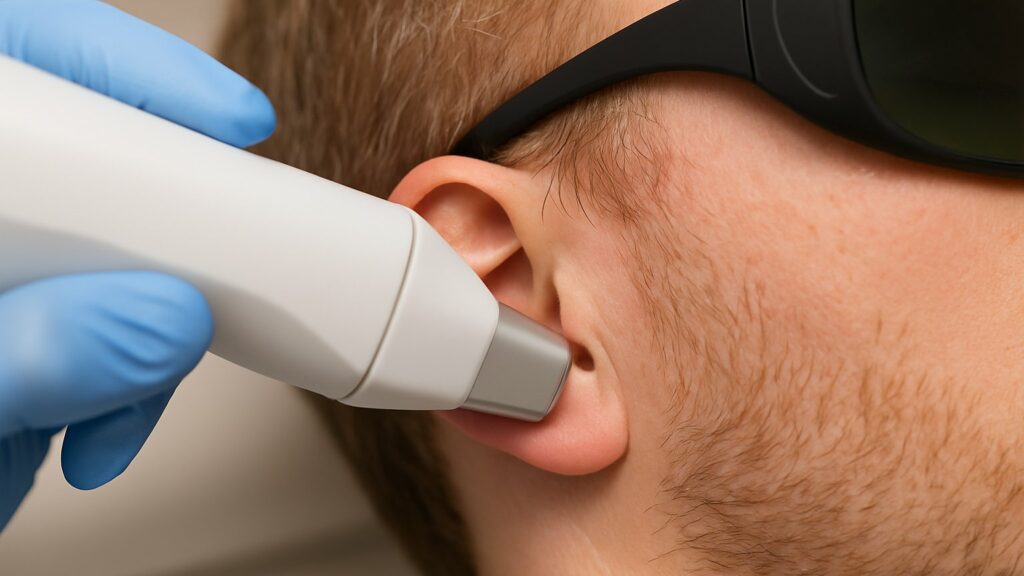
Ear hair is awkward to manage because growth sits across narrow rims, folds and delicate skin. Trimmers miss edges, plucking stings and regrowth returns. Laser offers longer-lasting reduction for dark hairs on the outer ear, while the ear canal stays strictly off limits.
The choice depends on hair density, maintenance preferences and whether strands contain enough pigment for laser targeting. Sudden or unusual changes deserve medical advice rather than cosmetic treatment.
Laser treatment is for visible hair on the outer ear
A practitioner may treat suitable hairs on the helix, antihelix, tragus, lobule and visible surfaces of the pinna. The boundary depends on anatomy, hair position and the safe handpiece angle. Hair within the canal is different. Laser energy should never be directed towards the canal, eardrum or an area that cannot be seen and controlled clearly.
Ear hair removal is a precision treatment, not a quick sweep across the ear. Protective eyewear, a clear treatment field, suitable settings and stable handpiece placement remain essential.
Temporary methods are useful, but each has a trade-off
The American Academy of Dermatology advises comparing methods according to skin, hair and the desired duration of results. Laser suits people seeking sustained reduction rather than another short grooming cycle.1
Why laser treatment can suit coarse, visible ear hair
Laser hair removal works through pigment. Melanin absorbs light, heat develops and the follicle's ability to produce strong regrowth is reduced. Treated hair sheds over the following days or weeks, while later sessions target follicles entering a responsive growth phase.2
Controlled treatment can reduce the wiry hairs that protrude from the rim and tragus.
A completed course may leave much longer gaps between visible regrowth and maintenance.
Fewer coarse hairs can mean less temptation to tweeze, scratch or repeatedly trim delicate folds.
Results vary. Dark, coarse hairs usually provide the clearest target. Blonde, red, grey and white hairs contain less useful pigment and may respond poorly, making electrolysis or trimming more sensible. Laser provides reduction, not a promise that every follicle stops permanently. Mayo Clinic notes that several treatments and occasional follow-up sessions may be needed.3
The Nu TriLaze Plus is the strongest BIL fit for ear treatments
All three British Institute of Lasers hair removal laser machines treat all skin types and share Alexandrite at 755 nm, Diode at 808 nm and Nd:YAG at 1064 nm. They are FDA approved, use SuperCool™ technology to help facilitate painless treatments, have intuitive controls, low maintenance and an approximate running cost of 1p for every 200 shots. Each includes a first-year guarantee covering 50 million shots, free Core of Knowledge learning, bespoke training and lifetime support.
For ear hair, the model-specific advantage belongs to the Nu TriLaze Plus professional hair removal laser machine. Its interchangeable precision tips improve access around small or awkward areas, including the ears. Broad, flat skin may suit a standard handpiece, while the helix and tragus reward a smaller, controlled treatment window. The built-in skin analyser also supports closer visual assessment of surface texture and visible features, although it is not a diagnostic device.
The following video shows how the interchangeable tips support exact positioning on detailed treatment zones.
The practical recommendationClinics offering ear, nose-edge, upper-lip and other detail-led treatments have a clear reason to favour the Nu TriLaze Plus. Its interchangeable tips provide a genuine workflow advantage.
Expect a series of brief appointments, not one permanent fix
The ears are small, so active treatment may be brief after positioning and safety checks. A course still takes time because follicles do not grow in sync. Several sessions may be spaced weeks apart, followed by a review of remaining density and maintenance needs.
Before treatment, the clinic should assess skin type, hair colour, sun exposure, medication, skin conditions, previous reactions and the treatment boundary. A patch test allows the skin response to be observed first. Plucking, waxing and electrolysis are normally paused because the follicle target must remain present. Shaving or careful trimming may be advised instead.
Cooling matters on thin, contoured skin. Mayo Clinic notes that built-in cooling can protect the skin and make treatment more comfortable.3 SuperCool™ contact cooling supports this on the Nu TriLaze Plus, although comfort still varies.
Good technique matters more on a small, uneven treatment area
Temporary warmth, redness and mild follicular swelling can occur. Less common problems include blistering, crusting, scarring or skin-colour changes. A 2024 study of 16,900 patients found a low complication incidence but identified head and neck treatment as requiring added care.4 This supports controlled settings, accurate placement and training for small facial areas.
Clients with Black or brown skin can receive laser hair removal, but wavelength and energy settings need care because skin melanin can also absorb energy. Research comparing long-pulsed 1064 nm Nd:YAG with IPL in darker skin found both usable safely and effectively, with Nd:YAG judged more effective in that study.5
- Ask where treatment stops. The practitioner should explain that the external ear may be treated while the inner canal remains excluded.
- Ask about tip size. A precision tip helps approach tight contours without treating a wider area than necessary.
- Ask about skin experience. The clinic should explain wavelength choice, patch testing, cooling and setting adjustments.
- Ask about light hairs. A credible consultation explains when grey, white or very fine hair is unlikely to respond.
You have only a few light hairs, want the lowest upfront cost or prefer to manage the area yourself.
Visible dark hairs return frequently, regular trimming is irritating and you want a longer-lasting reduction delivered by a trained practitioner.
See how precision tips change small-area treatments
Clinic owners can review the Nu TriLaze Plus handpiece, precision tips, interface, training and lifetime support during a no-obligation online demonstration or at the Coventry showroom.
Sources
- American Academy of Dermatology, hair removal options and patient guidance
- Mayo Clinic, how laser hair removal works
- Mayo Clinic, preparation, cooling, treatment course and results
- Lasers in Medical Science, laser hair removal complications and associated risk factors, 2024
- British Journal of Dermatology, long-pulsed Nd:YAG versus IPL for hair removal in dark skin