


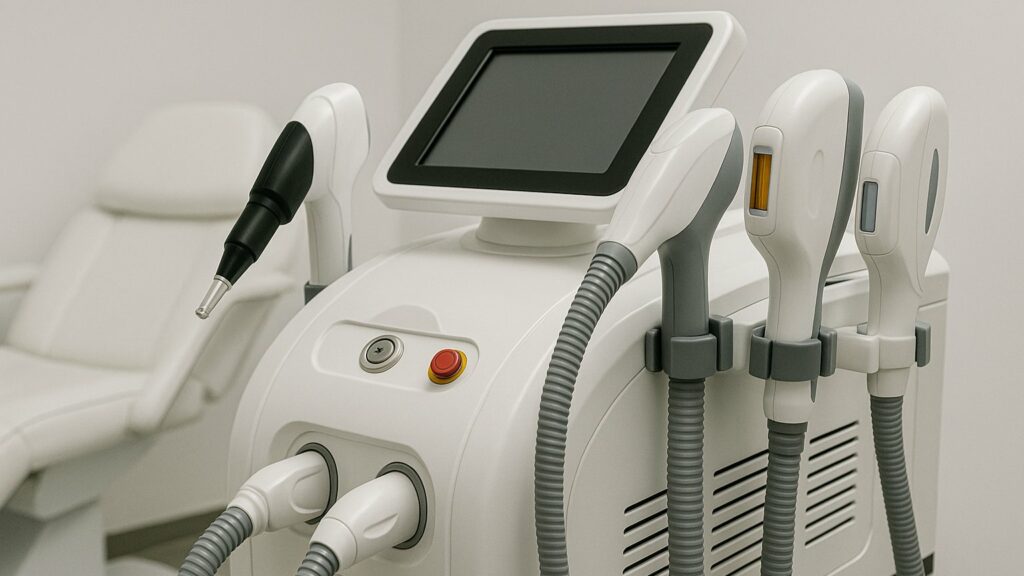
An all-in-one laser or light platform combines more than one treatment technology in a single cabinet or system. That can reduce floor space and simplify purchasing, but it can also concentrate several treatment functions, service dependencies and training requirements into one machine.
The useful question is not whether all-in-one is automatically better or worse. It is whether the technologies inside the platform genuinely suit the treatments you plan to offer, whether each function performs at the level you need, and whether the machine remains practical to train on, maintain and service.
What “all-in-one” actually means
The label can describe very different products. Some platforms combine several wavelengths used for the same treatment category. Others combine fundamentally different energy systems, such as hair-removal lasers, IPL and Q-switched tattoo-removal technology. Those are not equivalent propositions.
A multi-wavelength hair-removal system is still a specialist hair-removal platform. A cabinet combining hair removal, vascular or pigmentation IPL, tattoo removal and other functions is a broader generalist system with more treatment domains sharing one chassis.
Where a combined platform can make sense
- Smaller footprint. One cabinet may take less treatment-room space than several separate machines.
- Fewer separate purchases. A clinic can add several treatment categories without sourcing a different chassis for each one.
- Shared operating environment. Controls, consumables and maintenance processes may be easier to manage when the system has been designed coherently.
- Broader menu from one room. This can be useful where space, power provision or room allocation is constrained.
Why more functions can also create more failure domains
Every additional technology introduces its own handpieces, optics, cooling requirements, software logic, consumables and potential failure points. If several services depend on one chassis, a single machine fault can affect more of the clinic diary than a fault on one specialist machine.
That does not make a combined system unreliable by definition. It means serviceability matters more. Before buying, ask what can be diagnosed remotely, which components can be replaced independently, whether one failed treatment module disables the whole platform, what parts are held in stock and what support is available if the machine cannot be repaired promptly.
Compare treatment depth, not the number of menu buttons
| Question | Specialist system | Broad all-in-one system |
|---|---|---|
| Primary purpose | Optimised around one treatment family | Covers several treatment families |
| Training burden | Usually narrower | Usually broader because each modality needs separate competence |
| Downtime exposure | A fault affects one treatment category | A chassis-level fault can affect several services |
| Room footprint | May require several machines | Can reduce the number of cabinets |
| Buying comparison | Compare depth of performance in one field | Compare each included technology separately, not just the combined feature list |
One machine does not mean one competency
A practitioner who is competent with laser hair removal is not automatically competent with tattoo removal, IPL pigmentation work or another modality simply because the controls sit on the same cabinet. Training, consultation, contraindications, patch testing, eye protection, treatment endpoints and aftercare can differ materially between technologies.
Ask the supplier what training is included for each function, who the training is intended for, whether local licensing or insurance requirements differ by treatment, and how competence is documented.
Separate purchase price from lifetime operating cost
A combined platform can look economical because one purchase opens several treatment categories, but total ownership cost depends on handpiece life, lamps or other consumables, filters, water or cooling maintenance, servicing, calibration where relevant, replacement parts and the cost of downtime.
Ask for treatment-specific running-cost information rather than one blended figure for the whole machine. A low-cost hair-removal function does not tell you the operating cost of a separate tattoo or IPL module.
For clinic revenue, break-even and diary-utilisation maths, use the separate laser hair removal profitability guide. This article is intentionally focused on machine architecture and ownership decisions rather than salon financial modelling.
What to establish before choosing a combined platform
- Which exact technologies and wavelengths are included, and which treatment indications does each one support?
- Does each modality have its own dedicated handpiece, optics and cooling path?
- Can one treatment module remain operational if another module develops a fault?
- Which consumables and replacement parts are normally held in stock?
- What servicing can be completed on site, remotely or by replacing a module?
- What training is supplied for each treatment category?
- What warranty and replacement-support terms apply to the complete chassis and to individual handpieces?
- What evidence supports any regulatory claim for the exact device and legal manufacturer?
- What are the expected running costs for each modality at realistic treatment volumes?
- Would two specialist systems give the clinic better resilience even if they use more floor space?
The practical conclusionAn all-in-one system is useful when its individual technologies are strong enough for the clinic’s actual treatment mix and the support model accounts for the extra complexity. Do not buy the longest treatment menu. Compare each modality as if it were a separate machine, then decide whether combining them into one chassis genuinely improves the clinic.