Precision in every detail

Calibrating experience

00%

Should Your Laser machine be FDA Approved And Medical CE Certified?

Equipment descriptions can become confusing very quickly. A supplier may refer to FDA approval, CE marking, UKCA marking, medical certification and electrical compliance in the same conversation, even though these terms do not mean the same thing or…

In this guide

Equipment descriptions can become confusing very quickly. A supplier may refer to FDA approval, CE marking, UKCA marking, medical certification and electrical compliance in the same conversation, even though these terms do not mean the same thing or apply in every market.

For a UK salon or clinic, the useful question is not whether the machine carries the longest collection of regulatory logos. You need to understand its intended purpose, whether it is legally classed as a medical device in the market where it will be supplied, and what evidence supports its safety, performance and ongoing use.

The Main Distinction

Medical CE certification is not automatically required in Great Britain

The phrase "medical CE certified" is often used loosely. CE is a conformity marking rather than a general badge showing that every aspect of a product has been independently approved. The applicable assessment process depends on the product, its classification, its intended purpose and the legislation under which it is placed on the market.

In Great Britain, which means England, Scotland and Wales, the MHRA says that medical-device status is determined by the manufacturer's stated intended purpose and the product's mode of action. The labelling, instructions and promotional claims all matter. Equipment does not automatically become a medical device because it is used in a salon, clinic or healthcare setting.1

A hair removal laser machine supplied solely for professional cosmetic hair reduction, without claims that it diagnoses, prevents, monitors or treats disease, may therefore sit outside the medical-device framework in Great Britain. In that situation, medical-device CE certification is not an automatic legal requirement.

This does not mean the equipment is unregulated. Products outside the medical-device rules must still be safe for their intended purpose and may be covered by electrical safety, electromagnetic compatibility, workplace safety and wider product legislation.

The British Institute of Lasers does not describe its machines as medically certified. They are supplied for their stated professional cosmetic purposes and should not be promoted as diagnostic devices or as equipment for treating medical conditions.

UK Market Differences

Great Britain and Northern Ireland do not follow identical rules

References to "the UK rules" can hide an important distinction. The UK Medical Devices Regulations 2002 apply in Great Britain, while the EU Medical Devices Regulation applies in Northern Ireland under the Windsor Framework.2

The EU framework also brings certain products without a medical purpose into its scope. Annex XVI includes categories of aesthetic equipment with risk profiles similar to medical devices. European rules specifically cover some high-intensity laser and IPL equipment intended for hair removal, tattoo removal and other skin treatments.3

A machine that can be supplied for cosmetic use in England, Scotland or Wales without medical-device CE certification may face different conformity requirements when supplied in Northern Ireland or the European Union. Manufacturers, importers and clinics should check the intended market rather than assuming one answer applies across every part of the UK.

FDA Status

FDA approval is useful evidence, but it is not a UK licence

The FDA regulates medical devices sold in the United States. Its requirements do not replace British product, workplace, insurance or local-authority obligations.

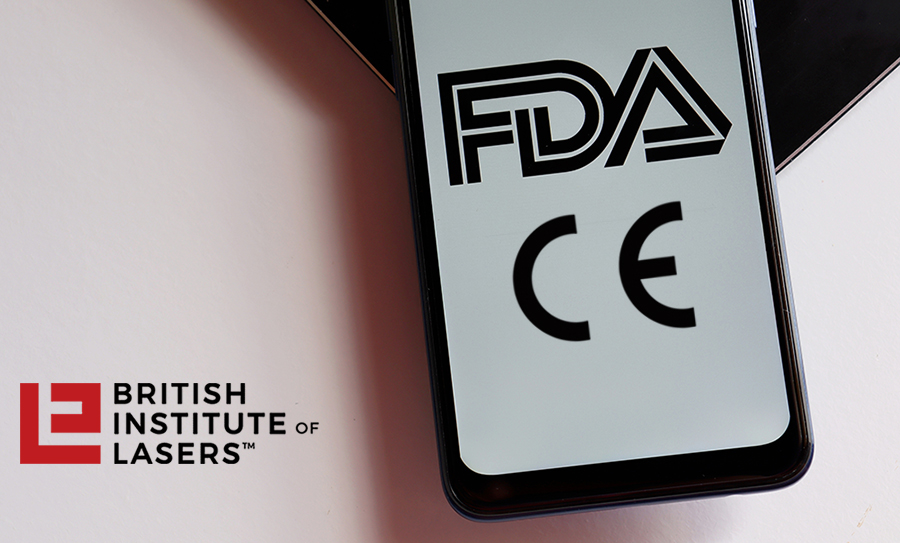
The current British Institute of Lasers range is FDA approved. This provides a useful additional point for clinics assessing equipment, but it should be understood in context. FDA status does not automatically confirm that a clinic meets local licensing conditions, that an insurer will accept every proposed treatment, or that a practitioner can operate without suitable training.

The FDA also uses more than one regulatory pathway. Some devices receive premarket approval, while many are brought to market through the 510(k) clearance process after the FDA determines that they are substantially equivalent to an existing legally marketed device.4

When assessing unfamiliar equipment, ask for the exact device name, manufacturer and regulatory record. A logo on a brochure is weaker evidence than a record that can be matched to the machine being purchased. FDA establishment registration or product listing should not be presented as though it were the same as device approval or clearance.

Wider Product Safety

A non-medical cosmetic machine still needs a sound compliance foundation

Electrical equipment placed on the Great Britain market must meet the applicable safety requirements. Manufacturers may need technical documentation, a declaration of conformity and the appropriate product marking under electrical and electromagnetic compatibility rules.5

A serious equipment review should look beyond one certificate. Request information covering:

  • The stated intended purpose. Check that the instructions and marketing claims match the treatments the clinic plans to provide.
  • The manufacturer and supplier. Establish who is responsible for parts, technical queries, repairs and safety notices.
  • Electrical and product documentation. Confirm that the equipment is suitable for the Great Britain market and supplied with appropriate instructions.
  • Laser classification and protective measures. Check eyewear, controlled-area requirements, signage and access controls.
  • Training and support. Interface operation alone is not enough. Practitioners need consultation, contraindication, patch-testing and setting-selection guidance.

All British Institute of Lasers machine purchases include free Core of Knowledge learning and bespoke training. Depending on the machine and practitioner, this may cover laser science, treatment settings, consultation, patch testing, contraindications, documentation, maintenance and aftercare. Lifetime support is also included for operational questions, troubleshooting and refresher guidance.

Clinic Responsibilities

Machine documentation does not replace safe operation

High-powered lasers can cause serious eye injuries and skin burns when poorly controlled. The Health and Safety Executive states that employers must manage risks from hazardous artificial optical radiation in the workplace.6

The clinic may need risk assessments, local rules, suitable protective eyewear, controlled treatment areas and advice from a Laser Protection Adviser. Access to discounted Laser Protection Adviser services is available with a British Institute of Lasers machine purchase, although this does not guarantee council approval, insurance acceptance or automatic legal compliance.

Licensing also varies by location. Cosmetic laser practitioners in England do not generally need CQC registration solely because they provide cosmetic treatment, although some councils require local registration or a special-treatment licence. Wales requires registration with Healthcare Inspectorate Wales for IPL and class 3B or class 4 laser treatments.7

Before opening the diary, confirm local-authority rules, insurance conditions, practitioner requirements and room-safety arrangements. The guide to laser hair removal qualifications, licences and insurance provides a useful starting point.

What should a UK buyer prioritise?

FDA status can strengthen confidence in a machine, but medical-device CE certification is not automatically required for cosmetic laser equipment used in Great Britain. The intended purpose and product claims decide which regulatory framework applies.

Look for clear documentation, a traceable manufacturer, suitable product conformity, professional training, dependable parts and repairs, realistic treatment capabilities and long-term support. Those details matter far more in daily clinic use than a vague claim that a machine is "medically certified".

Check the machine and its intended use before making a decision.

A no-obligation demonstration allows you to review the equipment, controls, training, maintenance and supporting documentation. Regulatory requirements can then be considered alongside your location, insurer, treatment menu and available room.

Dr Majid Zarandouz
Written by

Majid holds a PhD in organic chemistry and has been working with laser systems for decades. His career began in the mid-1990s, when he started researching and developing laser-based technologies for medical and cosmetic applications. Over the years, he has combined scientific expertise with practical engineering to design machines that are effective, durable, and straightforward to use in real clinic settings. As director of the British Institute of Lasers, Majid continues to focus on producing equipment that meets professional standards while remaining accessible to businesses of all sizes.

Equipment Maintenance Laser Hair Removal Uncategorized
Choose with confidence

See the British Lasers range in a personal demonstration.

Compare suitable machines around your room space, treatment plans, team and expected appointment volume.

Scroll

Our site uses cookies. By using this site, you agree to the Privacy Policy and Terms of Use.