
A laser hair removal clinic rarely struggles because nobody wants the treatment. The harder problem is local competition. Prospective clients can compare prices, reviews, treatment rooms and practitioner profiles within minutes, then postpone the decision because several clinics look much the same.
Good clinic marketing reduces that uncertainty. It helps the right person find you, understand whether the treatment suits them, trust your standards and take a small next step, usually a consultation or patch test. The work is less glamorous than chasing viral posts, but far more dependable: a clear local position, useful service pages, visible proof, prompt follow up and careful measurement.
Give people a specific reason to choose your clinic
"Professional laser hair removal" is expected, not distinctive. A useful position is narrower and easier to repeat. You might be known for discreet facial hair treatments, evening appointments for commuters, careful work with darker skin tones, a calm first appointment for anxious clients, or straightforward course pricing with no awkward sales pressure.
Choose a position you can support in practice. If you promote suitability for all skin types, your equipment, training, consultation process and patch testing must support that statement. If convenience is the promise, online booking, opening hours and appointment reminders need to feel convenient too.
A useful one sentence test Complete this without using "high quality", "friendly" or "affordable": "Clients choose us because..." The answer should point to a real strength, not a general compliment that every competitor could use.
Build pages around client decisions, not clinic departments
A single treatment page often tries to cover too much. Someone researching upper lip treatment has different concerns from a client considering full legs or a male client comparing back and shoulder packages. Dedicated pages for important treatment areas give you room to discuss preparation, typical appointment time, course structure, comfort, aftercare and pricing without producing a wall of generic copy.
Each page should answer the practical questions that can stop a booking:
- Who may be suitable? Explain consultation and patch testing, relevant contraindications and why outcomes vary.
- What will it cost? Publish clear session prices, course prices or a meaningful range. The guide to laser hair removal costs for clinics and clients can help you frame pricing information.
- What happens next? Use one prominent action, such as booking a consultation, requesting a call or choosing an appointment time.
- Can the page be trusted? Show the named practitioner, relevant qualifications, real room photography, equipment details and balanced answers about results.
Mobile usability deserves blunt testing. Ask someone who has never used your site to find the price of underarm treatment and book a consultation on an ordinary phone. Watch where they hesitate. That short exercise usually exposes more than another design meeting.
Make your clinic easy to verify on Google
Laser hair removal is usually a local purchase, so your Google Business Profile matters as much as your homepage. Google advises businesses to keep profile information complete, accurate and current because this can improve visibility in local results. 1 Use the same clinic name, address and phone number across your website, profile and reputable directories. Add accurate opening hours, treatment categories, an appointment link and recent photographs that help a first time visitor recognise the entrance.
Local search also depends on the website. Create useful location context rather than repeating the town name unnaturally. Mention parking, public transport, accessibility and the areas you realistically serve. A detailed treatment page plus strong local information is more persuasive than dozens of thin pages targeting neighbouring towns.
Clinics that need structured help with organic visibility can review SEO and AI search visibility for beauty salons. The sensible aim is discoverability for relevant local searches, followed by a page that earns the enquiry.
Show the standards behind the treatment
Prospective clients are not only comparing prices. They are quietly checking whether the clinic feels safe, whether the practitioner understands their skin and whether they will be pressured into a course. Your marketing should answer those concerns before the consultation.
Useful proof includes practitioner introductions, training certificates, insurance information, consultation procedures, patch testing, aftercare guidance and clear explanations of the equipment being used. For operational guidance, link readers to accurate information on qualifications, licences and insurance for laser hair removal rather than making broad claims about compliance.
Reviews are strongest when they are recent, specific and collected steadily. Ask after a client has had enough treatment to comment meaningfully, make the review link easy to open and reply with care. UK guidance now addresses fake reviews and concealed incentives directly, so never buy reviews, write them for clients or hide a reward attached to a review request. 2
Record the ordinary details clients want to see
Social media works best when it reduces unfamiliarity. A polished poster announcing "smooth skin" says very little. A short clip showing the room, protective eyewear, cooling, positioning and the practitioner's explanation gives a nervous client something concrete to assess.
The following video demonstrates the sort of close, practical treatment footage that can support educational social posts. Your own version should use real clinic surroundings, a clear explanation and appropriate client permission.
Plan content around one client question at a time: shaving between sessions, sun exposure, facial hair, comfort, course spacing or what a patch test involves. Avoid posting identifiable client material on the strength of an informal conversation. Where consent is the lawful basis, ICO guidance says the request should be clear, separate, recorded and capable of being withdrawn. 3
Use advertising after the booking journey is ready
Google Ads can reach people actively searching for treatment, while social advertising can introduce the clinic to people who were not searching that day. Neither channel repairs a vague offer, a slow website or unanswered enquiries. Fix those first.
Send every campaign to a relevant landing page rather than the homepage. An advert for men's back treatment should lead to a page about that service, with pricing, suitability, proof and a direct enquiry route. Add call tracking or a dedicated form so you can distinguish paid enquiries from organic ones. Clinics planning paid search can read more about PPC campaigns for beauty businesses.
Set a test budget you can maintain long enough to learn. Then use clinic numbers, not likes, to judge it:
Estimate the commercial picture behind an ad campaign
Change the figures to reflect your clinic. This is a planning illustration, not a revenue forecast.
Gross course revenue before wages, premises, consumables, machine finance, tax, refunds and other costs. Actual performance depends on lead quality, response time, consultation conversion and course completion.
Promote a useful next step, not a permanent discount
Heavy discounts can fill a diary briefly, then train clients to wait for the next offer. Better promotions reduce the risk of starting: a clearly priced consultation, a seasonal course package with an honest saving, or a limited launch offer for a new treatment area. State the terms, end date and normal price clearly.
Response speed matters just as much as the advert. Decide who owns new enquiries, how quickly they should reply and what information they need. A calm message that answers the person's question and offers two consultation times is more useful than a generic "call us" response.
Once somebody begins treatment, rebooking, reminders and progress conversations become marketing too. A client who completes a course is more likely to leave an informed review, return for maintenance and recommend the clinic. Measure course completion as carefully as new enquiries.
A practical monthly scorecard
- Visibility: Local search views, website visits and treatment page traffic.
- Response: Enquiries, response time and consultations booked.
- Conversion: Consultations attended, courses sold and cost per new client.
- Retention: Rebooking rate, course completion, reviews and referrals.
Review the same figures each month. If traffic is healthy but bookings are weak, the problem is probably the page, offer or follow up. If clients start but do not finish, more advertising only makes the leak more expensive.
Keep claims careful, specific and supportable
Laser hair removal advertising falls within ASA and CAP guidance for non surgical cosmetic interventions. Claims should be capable of substantiation, promotions should not trivialise the decision and advertising must not be directed at under 18s. 4 Review the current guidance before launching a campaign, particularly when using treatment claims, client images, testimonials or time limited offers.
Describe what your clinic does and how it works. Avoid promising identical comfort, permanent removal for every client or guaranteed results. Balanced language may appear less dramatic, but it attracts people who understand the commitment and are better prepared for consultation.
Make the clinic easier to find, easier to trust and easier to book.
British Institute of Lasers provides marketing support for beauty and aesthetics businesses across website design, SEO, AI search visibility and paid advertising. Explore the approach and discuss the channels that fit your clinic rather than buying activity you cannot measure.
Sources
- Google Business Profile Help, tips to improve local ranking
- Competition and Markets Authority, guidance for businesses publishing consumer reviews
- Information Commissioner's Office, obtaining, recording and managing consent
- ASA and CAP, guidance on marketing surgical and non surgical cosmetic procedures
Buying a capable laser machine is the easy half of building a hair removal business. The harder half is making sure the right people in your area know you exist, trust you enough to book a consultation, and stay for a full course of sessions.
This guide walks through the marketing approaches that consistently work for UK clinics, in the order we would tackle them: foundations first, visibility second, paid spend only once the basics can convert it. PolicyBee's published industry statistics estimated that the UK aesthetics sector could be worth £3.6 billion in 2025. That scale brings plenty of competition, so a clear local position matters.1
Decide who you are for before you spend a penny
Most clinic marketing fails before it starts, because the clinic never decided what it wants to be known for. "Laser hair removal near me" is a category, not a position. Before building a single ad or post, write down three things and make every marketing decision agree with them:
- Who you serve best. A clinic confident across Fitzpatrick skin types I to VI has a genuinely different story from one focused on speed and convenience for office workers. Pick the client you most want more of.
- Where you sit on price. Premium consultation-led care, mid-market value, or volume pricing all work, but mixing their signals confuses people. Your photography, tone and offers should all say the same thing.
- What you can prove. Qualifications, training certificates, machine credentials, insurance, years of experience and genuine reviews. Proof beats adjectives in this industry every time.
Why this matters commerciallyA course of laser hair removal is a considered purchase, often several hundred pounds. People compare two or three clinics before booking. Positioning is what makes you the obvious choice for your kind of client rather than one of three near-identical tabs.
Build service pages that answer real questions
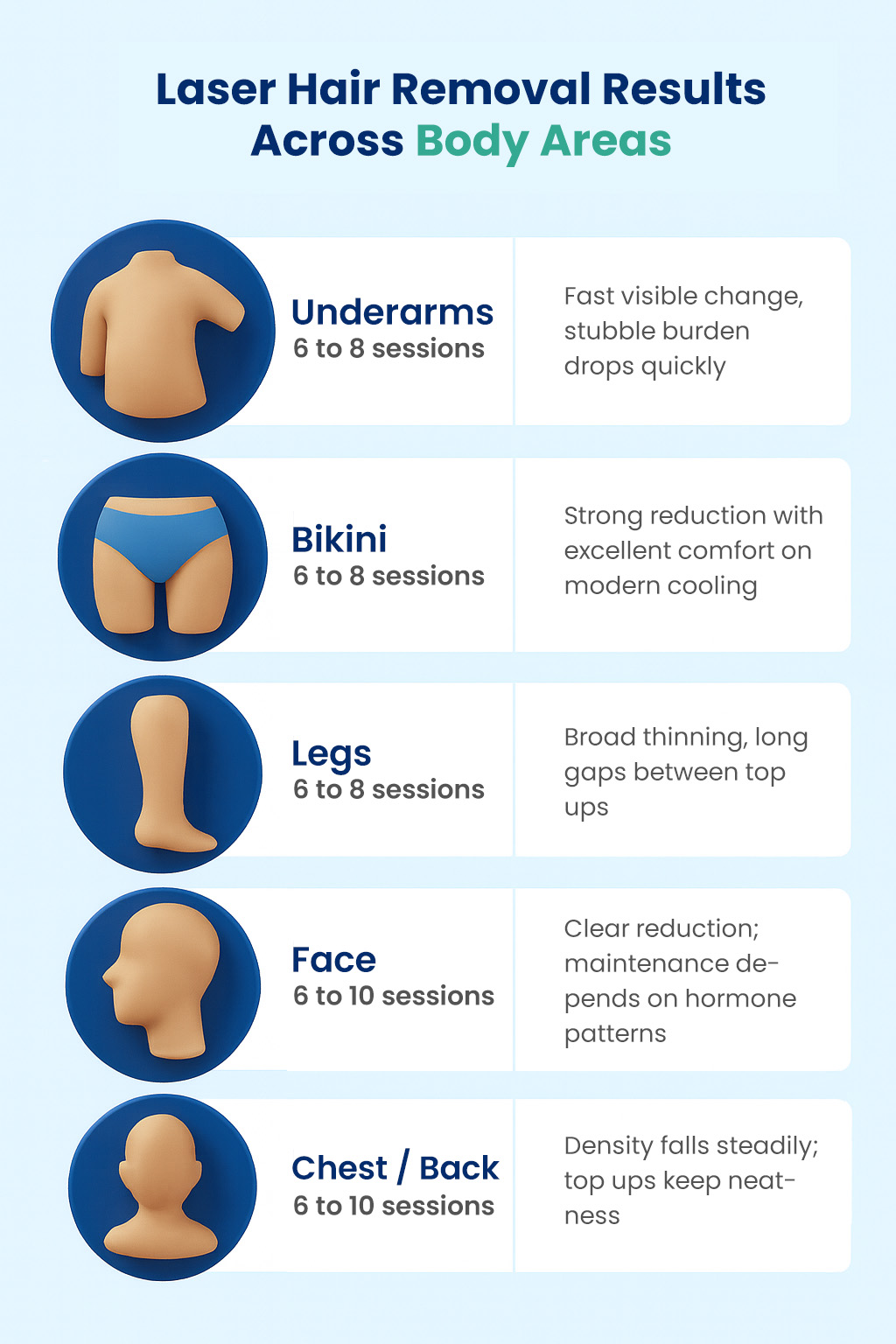
A single "Laser Hair Removal" page is not enough. People search the way they think: "underarm laser hair removal cost", "how many sessions for legs", "laser for facial hair". Each major treatment area deserves its own page covering what the treatment involves, how many sessions are typical, what it costs, and honest answers to comfort and suitability questions.
Structure each page around the questions a nervous first-timer actually asks, and be specific rather than salesy. Because expected session counts and results genuinely differ by body area, a visual summary helps readers orient themselves quickly. Below you will find a visual guide which explains typical results across different body regions, the kind of expectation-setting graphic worth building into your own service pages:
- Make booking effortless. A prominent "Book a consultation" button on every page, an online calendar if you can support one, and a phone number that is answered. Every extra step loses a percentage of people.
- Show your prices, or at least a range. Hiding prices generates fewer, lower-quality enquiries. Clinics that publish clear pricing filter out mismatched clients before they cost you consultation time.
- Keep it fast on mobile. Most local searches happen on a phone. Compress images, avoid heavy sliders, and test your own site on a mid-range handset, not just your office desktop.
Own your local search results
For a clinic serving a 10 to 15 mile radius, local search is usually the highest-value channel and it is largely free. The centre of it is your Google Business Profile, the listing that appears in the map pack when someone searches "laser hair removal" plus your town.
- Complete every field of your Google Business Profile. Categories, services with descriptions and prices, opening hours, real interior and exterior photos, and posts when you have genuine news. Complete profiles consistently outrank sparse ones.
- Collect reviews steadily, not in bursts. Ask every happy client at the end of a course, make it a one-tap link, and reply to every review including the awkward ones. A steady flow of recent reviews matters more than a big historic total.
- Keep your name, address and phone number identical everywhere. Website footer, Google, Facebook, directories. Inconsistent details quietly erode local rankings.
- Write for your area. A page or post that genuinely helps people in your town, parking, access, local FAQs, gives search engines a reason to associate you with the place you serve.
Educate before you sell
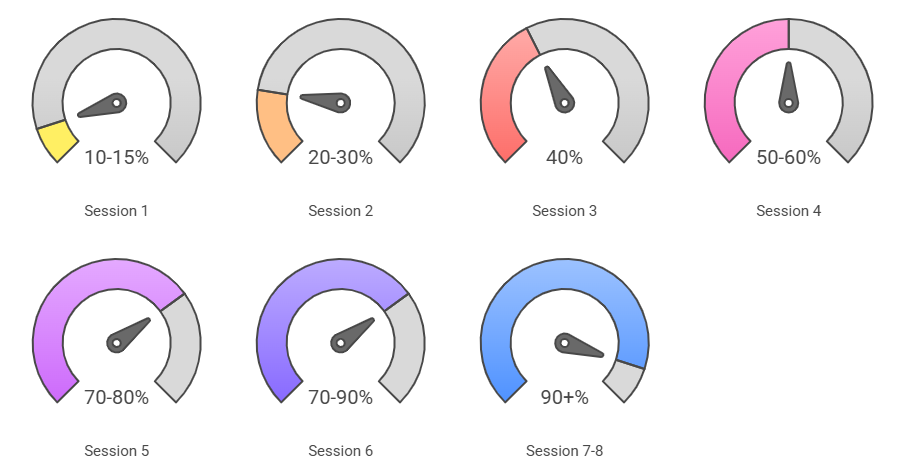
Laser hair removal has a knowledge gap that works in your favour. Most prospective clients do not understand why results take multiple sessions, why they cannot wax between appointments, or why outcomes differ between people. Clinics that explain these things clearly win trust before price is ever discussed, and educated clients complete their courses at far higher rates.
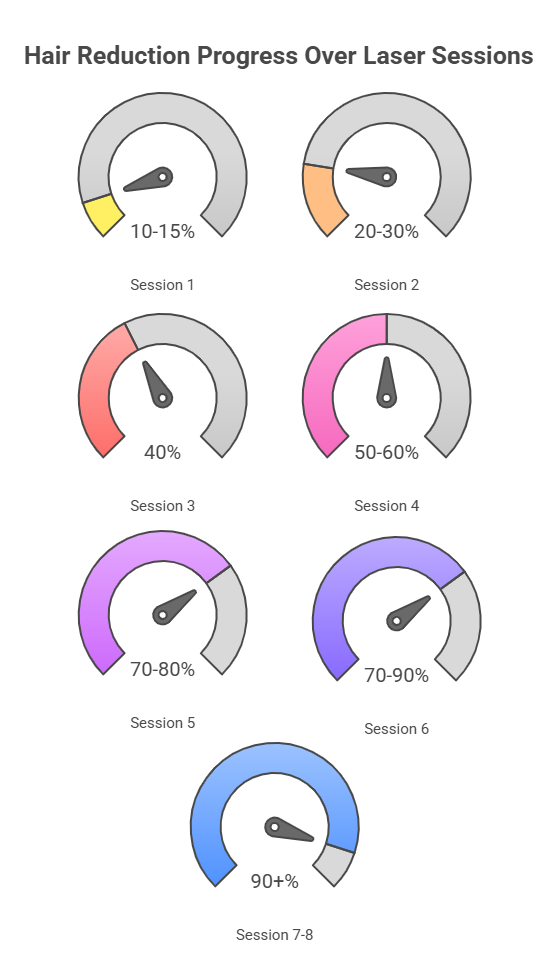
Blog articles, FAQ pages, consultation scripts and social captions should all draw on the same honest explanations. Managing expectations around progress is the single most valuable topic. Below you will find a visual guide which explains how hair reduction typically builds across a course of sessions, exactly the kind of graphic that turns an abstract promise into something a client can picture:
Content that convertsOne thorough, honest article answering "how many sessions will I need" will outperform ten generic "benefits of laser hair removal" posts. Depth on the questions people genuinely worry about is the whole strategy.
Show real work on social media
Instagram and TikTok suit this industry because the service is visual and the anxieties are personal. The clinics that grow on social media are not the ones with the glossiest graphics. They are the ones that show real treatments, real rooms and a real practitioner answering the questions people are embarrassed to ask.
- Short treatment clips outperform posters. A 20-second clip of a patch test or an underarm session, with a calm voiceover explaining what is happening, does more reassurance work than any stock image.
- Get written consent for every client image or video. Store the consent form with the client record. Never post identifiable content on an informal verbal yes.
- Answer one question per post. "Does it hurt?", "Can I shave between sessions?", "Why can I not have a tan?" Each is a piece of content, and together they build a searchable library of trust.
- Show the practitioner, not just the machine. People book people. A recognisable face in your content measurably lifts consultation requests.
Run paid ads with a calculator, not a hunch
Paid advertising works for laser clinics, but only once the foundations above can convert the clicks it buys. Google Ads captures people already searching for treatment in your area, which makes it the usual starting point. Meta ads on Facebook and Instagram build awareness with people who were not searching yet, and tend to need more creative testing before they pay.
Two practical warnings. First, Meta restricts certain imagery in ads, including some before-and-after formats and close-up body imagery, so build campaigns around treatment-room footage and practitioner-led explanation rather than skin close-ups. Second, set a monthly budget you can sustain for at least three months. One-week experiments prove nothing.
Before spending anything, work out what a client is worth and what you can afford to pay to acquire one. Use the calculator below with your own numbers:
Marketing maths: what can you afford to spend?
Illustrative planning tool. Adjust the sliders to match your clinic and see the monthly picture update.
Gross revenue before staff, premises, machine finance, insurance, tax and other costs. Course values assume clients complete their course, which is why the retention work in the next section matters as much as the ads.
Turn happy clients into your best channel
Every marketing pound works harder when clients stay for full courses and send their friends. This is the cheapest growth available to a clinic and the most neglected.
- Sell courses, not single sessions. A fairly priced course of six or eight aligns the client with how the treatment actually works, improves their results, and stabilises your cash flow.
- Book the next appointment before they leave. Clients who walk out without a booked session are the ones who drift. Rebooking at reception is the highest-converting sales conversation you will ever have.
- Run a simple referral thank-you. A discount or add-on for both parties, mentioned at the moment a client is delighted with progress, usually around session three or four.
- Use reminders and progress check-ins. A text before each appointment and a short "here is how far you have come" note mid-course reduce no-shows and abandoned courses.
Stay inside the advertising rules
Aesthetic advertising in the UK is watched closely, and a single upheld complaint can undo years of reputation building. The rules are not complicated, but they are unforgiving of exaggeration.
The claims that get clinics in trouble
- Avoid absolute promises. "Permanent", "painless" and "guaranteed" are the words that attract complaints. "Long-term hair reduction" and "designed for comfort" are honest and defensible.
- Before-and-after images must be genuine and typical. Same lighting, same angle, no editing, and ideally labelled with the number of sessions between the photos.
- Reviews must be real. Never publish incentivised or invented reviews as organic ones. Consumer protection rules treat fake reviews as a serious breach, and platforms remove them.
- Substantiate what you claim. If an ad says "suitable for all skin types", your equipment, training and consultation process need to back that up.
Check the current CAP Code guidance on cosmetic interventions before each new campaign, and when in doubt, describe rather than promise. The honest version of your marketing is also the version that converts cautious, high-value clients.
Measure what matters, monthly
You do not need a dashboard suite. You need five numbers reviewed on the same day each month: enquiries, consultations booked, courses sold, cost per new client from paid channels, and the percentage of clients completing their course. Together they tell you whether the problem is visibility, conversion or retention, which are three different fixes.
Use the checklist below as a working audit. Tick off what is genuinely in place today, and treat whatever is left as your marketing plan for the next quarter:
Your clinic marketing audit
0 of 8 in placeFrequently asked questions
A common working range for an established local clinic is 5 to 10 percent of target revenue, weighted higher during launch or expansion. More useful than a percentage is the calculator approach above: know your average course value and acceptable cost per client, then set spend at a level you can sustain for at least three months while you learn what works locally.
Yes, with care. Images must be genuine, unedited, taken in comparable conditions and representative of typical results, with written client consent on file. Note that Meta restricts some before-and-after formats in paid ads, so keep those images for your website and organic posts, and build ad creative around treatment footage and practitioner explanation instead.
Usually Google first. It reaches people already searching for treatment in your area, so it converts sooner and teaches you your real cost per enquiry quickly. Meta ads work well as a second channel once your organic social proof exists, because people who see an ad will check your profile before booking.
Paid search can generate enquiries in the first week, but treat the first three months as a learning period while you refine targeting and landing pages. Local SEO and review building compound over six to twelve months. Retention and referral improvements pay back fastest of all, because they work on clients you have already paid to acquire.
Marketing fills the diary. The machine and the numbers decide the margin.
If you are still weighing up equipment, or want to sense-check the commercial side of a clinic before scaling your marketing, the clinic profitability guide works through the numbers honestly.
Laser hair removal is one of the most commercially attractive treatments a clinic can offer, but it sits in a corner of the beauty industry where the paperwork genuinely matters. Qualifications, licensing and insurance are not three versions of the same box-tick. They are three separate systems, run by different organisations, and a gap in any one of them can stop you trading.
This guide walks through all three in plain English: what training the industry expects, when a licence applies, what a proper insurance stack looks like, and the order to tackle it all in so nothing gets bought twice or missed entirely.
First, the context that makes this worth doing properly. This is a growing market with real money in it, and growing markets attract scrutiny from councils, insurers and clients alike:
What qualifications do you need for laser hair removal?
There is no single national certificate that unlocks laser hair removal across the UK. What exists instead is a stack of training that councils and insurers expect to see, and in practice their expectations are what define the entry requirements. Miss a layer and you may find you can buy a machine but cannot insure it, or can insure it but cannot satisfy your local authority.
The table below sets out the stack in the order most people build it:
| Qualification | What it covers | Who needs it |
|---|---|---|
| Level 3 Beauty Therapy (NVQ or equivalent) | Anatomy, physiology, skin biology and professional practice. The common entry expectation for advanced treatments, alongside an up-to-date professional register listing. | Practitioners entering from outside a healthcare background |
| Core of Knowledge certificate | Laser physics, hazards, eye and skin safety, controlled areas and safe operation of Class 3B and 4 devices. | Effectively everyone operating a laser. Most insurers and councils treat it as non-negotiable |
| Level 4 Laser & IPL (e.g. VTCT) | Supervised practical hours, client assessment, patch testing, treatment protocols and managing adverse reactions. | The industry benchmark that opens the widest choice of insurers |
| Machine-specific training | The settings, protocols, cleaning and maintenance for your exact device, with a Certificate of Training on completion. | Every operator of that machine. Included as standard with all of our laser and IPL systems |
| First aid, CPR and CPD | Emergency response, plus refresher and new-starter training as your team changes. | Strongly advisable for anyone treating the public; some insurers ask |
What is a "Core of Knowledge" certificate?
A short laser safety course covering how laser and intense pulsed light energy behaves, the hazards it creates, and how to run a safe controlled treatment area. It is not a treatment qualification on its own, but it underpins everything else: insurers ask for it, councils ask for it, and a Laser Protection Adviser will expect every operator to hold it. The Core of Knowledge is included at no extra cost with our machine training.
One practical point worth stressing: ask your insurer and council what they accept before you book any course. Training providers vary in quality and recognition, and the most expensive course is not automatically the most accepted one. Ten minutes of phone calls in the right order can save four figures spent on the wrong certificate.
Do you need a licence to perform laser hair removal?
This is where most of the confusion lives, because the honest answer depends on where your premises are and who is providing the treatment. In England, practitioners using lasers or IPL solely for cosmetic purposes are not required to register with the Care Quality Commission, even where the practitioner is a registered medical professional. Many new owners then assume that no licensing applies. The government's consultation sets out a proposed licensing framework for non-surgical cosmetic procedures, including laser treatments, so local checks still need to happen before you sign a lease or buy equipment.1
Regulation did not disappear. It moved to local and national bodies that differ across the UK. Select your nation below to see the picture that applies to you:
England: council by council
Depends on your local authority- No CQC registration is needed for cosmetic-only laser and IPL hair removal, whoever performs it.
- Many councils run their own registration or special treatment licensing. London boroughs in particular commonly require a special treatment licence, with a premises inspection for health and safety compliance before a certificate is granted.
- Council schemes usually check your training certificates, insurance, treatment protocols and laser safety arrangements as part of the application.
Phone your council's licensing team before you sign a lease. Requirements can differ between neighbouring boroughs.
Wales: national registration
Registration expected- Independent clinics using Class 3B or Class 4 lasers for treatment fall under Healthcare Inspectorate Wales registration.
- Registration involves demonstrating safe premises, trained operators, laser safety arrangements and proper record keeping.
- Budget time for the process. National registration is more involved than a council licence, so build it into your launch timeline rather than discovering it at the end.
Confirm current registration requirements with Healthcare Inspectorate Wales before committing to premises.
Scotland: reform in progress
Check current rules- Clinics run by registered healthcare professionals register with Healthcare Improvement Scotland.
- Rules for non-healthcare practitioners have been under active reform, with licensing of non-surgical cosmetic procedures moving through Scottish Government processes in recent years.
- Do not rely on last year's answer. The Scottish position has been the fastest-moving in the UK, so verify the current requirements at the point you plan to open.
Check current Scottish Government and Healthcare Improvement Scotland guidance before trading.
Northern Ireland: RQIA oversight
Confirm before trading- Regulation of independent clinics sits with the RQIA, the Regulation and Quality Improvement Authority.
- Whether registration applies depends on the service and who provides it, so the answer is specific to your setup rather than universal.
- Local council environmental health teams may also have expectations for premises offering laser treatments.
Contact the RQIA and your local council with a description of your planned service before launch.
Before you sign anythingThe single most expensive licensing mistake is committing to premises before speaking to the local authority. If a special treatment licence applies, your premises will be inspected before a certificate is granted, and a room that cannot pass inspection is a lease you are stuck with. Make the licensing call part of your property viewing checklist, not your opening week.
The laser safety roles councils and insurers look for
Whichever nation you trade in, a common thread runs through council applications and insurance proposals: evidence that laser safety is somebody's named responsibility, written down, and followed. Four terms come up constantly, and knowing them before you fill in a form makes every application smoother:
Laser Protection Adviser
An external qualified adviser who assesses your setup, helps produce your safety documentation and advises on compliance. Many councils require evidence of LPA appointment as part of licensing, and insurers view it as a strong signal of a properly run clinic.
Laser Protection Supervisor
The named person on your own team responsible for day-to-day laser safety: making sure the Local Rules are followed, eyewear is used, and the controlled area works as designed. In a small clinic this is usually the owner or lead practitioner.
Local Rules
The written safety procedures for your specific premises and machine: who may operate it, how the room is controlled, signage, eyewear, emergency steps and fault reporting. Usually drawn up with your LPA and kept where staff can actually read them.
Controlled Area
The defined treatment space where the laser can be used safely: interlocked or managed access, appropriate window coverings, warning signage and wavelength-rated protective eyewear for everyone inside while the machine is live.
In this industry your paperwork is part of the product. Clients are buying confidence, and councils and insurers are simply checking it exists.
Is insurance necessary for laser hair removal?
There is no single national law that says "a laser clinic must hold insurance". In practice, that distinction is meaningless. Many councils make insurance a condition of registration or licensing, no landlord or serious client expects you to trade without it, and the one cover that is a legal requirement, employers' liability, kicks in the moment you take anyone on. Laser treatments can go wrong in ways that cause real harm, including burns and permanent marking, and an uninsured claim of that kind lands on you personally.
Think of it as a stack rather than a single policy. Here is what each layer does and where it sits on the spectrum from legal requirement to sensible choice:
| Cover type | What it protects you against | Status |
|---|---|---|
| Employers' liability | Claims from your own staff for injury or illness caused by their work, including apprentices and some freelancers depending on how they work for you. | Legal requirement with staff |
| Treatment risk insurance | Claims arising from the treatments themselves: burns, pigmentation changes, scarring or an alleged failure in your professional duty of care. | Essential for laser work |
| Public liability | Injury to clients or visitors and damage to their property at your premises. A slip in reception is a public liability matter, not a treatment one. | Expected as standard |
| Products liability | Claims relating to products used on or sold to clients, such as a pre-treatment gel or aftercare product causing a reaction. | Usually bundled, check it is |
| Equipment cover | Your machine against damage, theft and breakdown. Worth aligning with your warranty and swap protection so the covers meet rather than overlap. | Strongly recommended |
| Business interruption | Lost income if an insured event stops you trading for a period, keeping finance payments and rent covered while you recover. | Worth weighing up |
The quiet way policies failMost insurance problems in this industry are not refused applications, they are voided claims. Policies carry conditions: patch tests performed and recorded, consultations documented, only named and trained operators using the machine, settings within protocol. Skip the patch test to squeeze in a booking and you may still be "insured" right up until the moment you need to claim. Your record keeping is what keeps the policy real.
What insurers and councils ask to see
Applications for cover and licences are far less painful when the evidence already exists in one folder. These are the documents that come up again and again. Build the folder before you need it, and every application afterwards becomes an attachment exercise rather than a scramble:
A realistic route from training to trading
Because training, licensing and insurance are run by different organisations, sequencing matters. Do them in the wrong order and you can end up paying rent on a room you cannot yet legally use, or holding a certificate your insurer does not recognise. This is the order that avoids the common traps:
-
Confirm the rules for your intended premises
Before training, before the lease, before the machine: one call to your council's licensing team (or the national regulator in Wales, Scotland or Northern Ireland) to learn exactly what applies at that address.
-
Get your baseline qualifications in place
Level 3 if you are entering from outside healthcare, then speak to two or three insurers about what they accept at Level 4 before booking a course. Their answer decides your training provider, not the other way round.
-
Complete the Core of Knowledge and machine training
Both arrive together when training is bundled with your machine purchase, which is why buying the device and the education as one package shortens this stage considerably.
-
Appoint an LPA and write your Local Rules
Your adviser helps produce the risk assessment, Local Rules and controlled area plan that both the council inspection and the insurance proposal will ask about.
-
Arrange insurance with the evidence folder ready
With certificates, LPA appointment and protocols in one place, quotes come back faster and more accurately, and you avoid paying for cover that assumes the wrong setup.
-
Pass inspection, then trade with the records to prove it
Licence granted, cover live, and from the first client onwards: consultation, patch test and treatment records kept as carefully as the takings. Those records are what keep the whole structure standing.
What does compliance actually cost?
Exact figures depend on your nation, council, insurer and how much training you already hold, so treat the ranges below as planning brackets rather than quotes. The useful insight is proportion: compliance is a modest slice of a clinic launch, and dramatically cheaper than a single uninsured claim or a lease you cannot licence.
| Item | Illustrative range | How often |
|---|---|---|
| Core of Knowledge course | Roughly £100 to £300, and included with our machine training | Once, with refreshers as advised |
| Level 4 Laser & IPL qualification | Commonly £1,500 to £3,500 depending on provider and practical hours | Once per practitioner |
| Machine-specific training | Included as standard with all of our laser and IPL systems | Per machine, per operator |
| LPA services | Often a few hundred pounds per year depending on visits and documentation | Annual arrangement |
| Council licence or registration | Varies widely by authority, from tens to several hundred pounds | Usually annual renewal |
| Combined insurance package | Commonly a few hundred pounds to low four figures per year by cover level | Annual premium |
Top tips for starting your own clinic
With the compliance structure understood, a few practical decisions shape everything else about your launch. Three deserve particular care.
Location matters more than fit-outAffordable rent is only the start. Think about how clients actually arrive: on foot, by public transport, or by car needing somewhere free to park. Visibility brings walk-in enquiries, decent street lighting makes evening appointments feel safe, and a scan of nearby competitors tells you whether the area needs another clinic or a different kind of clinic. Above all, match the location to the client you decided to serve: a fashion-forward crowd may suit a busy, well-connected area with a coffee culture, while an older demographic may prefer somewhere quieter with easy access.
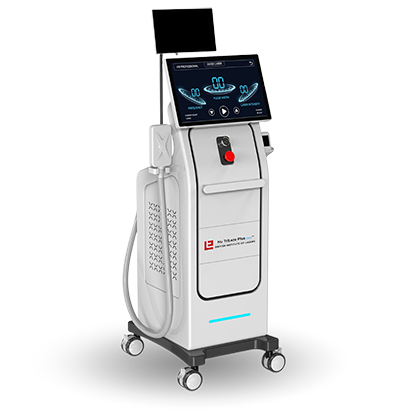
Bigger is not always betterA larger unit costs more to rent, heat and insure, and those costs arrive whether the diary is full or not. A smaller space limits how many clients you can treat at once, but it reaches profitability sooner and can always be outgrown deliberately rather than paid for speculatively. If you do take more space, treatment rooms can be leased to freelance therapists for income that does not add to your own workload. Compact, mobile machines help here: a system like the Nu TriLaze Plus fits smaller treatment rooms, comes with training included, and with a busy diary of average-priced treatments can cover its finance surprisingly quickly.
Choose a name and brand you can live withThe enjoyable part, done properly, is still a business decision. A strong clinic name is memorable, easy to say and spell, unique in your area, and available as a domain name. Carry the identity through consistently: colour schemes influence how a space feels, with blues and violets reading as calm and clinical confidence, so extend your palette from the treatment room to your cards, website and uniforms. Consistency is what makes a small clinic feel established.
Frequently asked questions
There is no single national statute naming one required certificate, but that does not make untrained practice viable. Councils that licence special treatments check training as a condition of the licence, insurers will not offer meaningful cover without recognised certificates, and trading without insurance leaves you personally exposed to claims for burns or scarring. In practical terms, the expectations of your council and insurer are the legal floor, so treat Level 3, the Core of Knowledge and machine training as your minimum stack and confirm the specifics locally.
Very often yes, and it is rarely worth resisting. Many council licensing schemes ask for evidence of LPA appointment, insurers look favourably on it, and the documents an LPA helps you produce, the risk assessment, Local Rules and controlled area plan, are the same ones every application asks for anyway. For a small clinic the cost is modest and it converts laser safety from guesswork into a documented system. The Laser Protection Adviser support page explains how the arrangement works.
Machine training plus a Core of Knowledge certificate satisfies some insurers, particularly where you already hold a Level 3 background, while others want a Level 4 laser qualification before offering full treatment risk cover. The market is not uniform, which is exactly why the sequencing in this guide puts the insurer conversation before the course booking. Ask two or three brokers what they accept, in writing, and build your training plan around the answer.
Assume not until confirmed. Council licences generally attach to the premises as well as the practitioner, so a move usually means a fresh application and inspection, and a move across a council boundary can mean entirely different rules. Insurers also need to know about a change of address, since your risk assessment, controlled area and Local Rules all describe a specific room. Build both notifications into any relocation plan from the start.
The machine is the easy part. We include most of this stack with it.
Every laser and IPL system we supply comes with training and certification included, covering machine operation and the Core of Knowledge, which clears two layers of this guide in one step. If you are planning a clinic and want to talk through the compliance route for your area, bring your questions to a demo.
Buying a tee shirt sight-unseen from the other side of the world is low stakes. If it arrives thin, late or nothing like the photo, you have lost a few pounds and an afternoon. A laser hair or tattoo removal machine is a different kind of purchase entirely: it is a Class 3B or Class 4 medical-grade device that you will point at people's skin, and the cost of getting it wrong is measured in injuries, insurance disputes and lost trading, not a refund request.
That does not make every machine manufactured overseas a bad one. Plenty of reputable equipment is built in China and elsewhere. The risk sits in a specific buying pattern: the unverified, direct-import bargain from a seller with no UK presence, no enforceable warranty, and certification you cannot actually check. This article weighs up that pattern honestly.
A direct-import bargain laser is usually a high-risk purchase
The sticker price is only the deposit. Once you add the odds of certification you cannot verify, a support chain that runs through customs, and insurance that may not recognise the device, the cheapest machine on the listing is rarely the cheapest machine to own. The old rule applies: only spend what you can afford to lose.
Why are these machines so cheap?
A price that undercuts the market by half is not magic, and it is not generosity. Something has been removed to reach it, and it is worth knowing what. At the bargain end, savings usually come from cheaper internal components and materials, thinner quality control, and none of the after-sale infrastructure, no UK support desk, no engineer network, no spares held locally, that costs a legitimate supplier real money to maintain.
There are supply-chain ethics in the mix too, which more buyers now weigh. Labour conditions and environmental standards vary enormously between manufacturers, and the very cheapest tier of any market is rarely where the strongest standards sit. It is a fair question to ask a supplier, and a telling one to hear them dodge.
The specific risks that flow from that cost-cutting are worth naming plainly:
Inaccurate specifications
If the stated wavelength, energy or pulse settings do not match what the machine actually delivers, you are treating clients on numbers you cannot trust. That is a route to burns and to claims.
Certification you cannot verify
A CE or FDA logo on a web page is an image, not proof. Marks are sometimes displayed on grey-market listings without the documentation to back them, and an unverifiable mark is worth nothing when a council or insurer asks.
No enforceable recourse
Consumer rights and warranty promises that sit outside UK law can be effectively unenforceable. A generous-sounding policy from an overseas seller is only as good as your ability to make them honour it.
Uninsurable in practice
Insurers can decline to cover a device they consider unsafe or non-compliant. A machine you cannot insure is one you cannot legally treat with, whatever you paid for it.
What the listing says, and what can happen
The gap between a persuasive product page and the experience of owning the machine is where most bargain purchases come undone. None of the following is guaranteed to happen, but each is a pattern buyers report often enough that it belongs on your radar before you pay:
When it breaks, the clock is against you
Every laser machine needs attention eventually. The question is not whether a fault appears but how quickly you can trade again once it does. With a UK-supported machine that is a phone call and often a swapped part. With a direct import and no local engineer, a single fault can turn into a return journey that empties your diary for weeks:
The purchase that quietly voids your cover
This risk stays hidden until the worst possible moment. Insurers assess the equipment behind the treatment. Where a machine cannot be shown to meet recognised safety standards, or is judged a hazard such as a fire risk, cover can be refused or a claim declined. UK laser-safety guidance also describes an LPA and documented local rules as standard parts of clinic risk management.1 At that point the sums invert completely: the money saved on the machine is dwarfed by an uninsured personal-injury or property claim you now carry yourself.
The maths that mattersA bargain that saves you a few thousand pounds is not a saving at all if it makes a single injury claim, a fire, or a licence refusal your personal liability. Cheap hardware and expensive exposure are not a trade worth making.
Score your supplier before you commit
Country of origin is not the real test. Verifiability is. Work through the checks below for any machine you are considering, wherever it is built, and tick only the ones you can genuinely confirm today. The gauge shows how exposed the purchase looks:
Supplier due-diligence scorecard
Tick each protection you can actually verify. More ticks, lower risk.
A guide, not a guarantee. Even a full set of ticks does not remove all risk, but a purchase scoring low here is one you can defend to a council, an insurer and, if it ever comes to it, a claimant.
What a lower-risk purchase looks like
None of this argues for overpaying. It argues for buying the machine and the safety net together, so the price you see is close to the cost you carry:
- Verifiable compliance, with certification documents you can hand to a council or insurer without a second thought.
- A UK support chain, so a fault is a call and a part, not a shipping label and a month of silence.
- Training included, clearing a qualification requirement in the same step as the purchase.
- People you can point to, a demo you can attend and owners you can ask, before any money changes hands.
Frequently asked questions
No, and it would be wrong to suggest so. A great deal of well-made, properly certified equipment is manufactured in China and imported through legitimate suppliers who stand behind it in the UK. The risk this article describes is not country of origin. It is the unverified, direct-import bargain bought from a seller with no UK presence, no enforceable warranty and certification you cannot check. Judge the supplier and the paperwork, not the map.
Ask for the underlying documentation rather than accepting a logo on a page. A genuine mark is supported by paperwork naming the standards met and the body that assessed the device, which you can cross-check. Be especially wary of a graphic used on its own with no certificate behind it, and remember that FDA clearance is a United States framework, so for a UK clinic it is CE and UKCA compliance that your council and insurer will actually want to see.
It can. Insurers look at the equipment as part of the risk they are pricing, and cover can be refused or a claim declined for a device that cannot be shown to meet recognised safety standards or that is judged a hazard. The simplest protection is to confirm the exact machine with your insurer in writing before you buy, which also happens to be one of the checks on the scorecard above.
Buy the machine, not the risk.
If you are weighing a bargain import against a UK-supported system, the honest way to decide is to see one in person, meet the people behind it, and confirm the compliance before you commit a penny. That is exactly what a demo is for.
Laser hair removal is a familiar service in UK clinics, and the potential client base is substantial. Hamilton Fraser reported that 5.6 million people in the UK were considering laser or IPL hair removal within the following year.2 For a new practitioner, that level of interest supports a credible career route, provided the training, insurance and equipment choices are sound.
If you want a skilled, people-facing role in a growing field, training as a laser hair removal technician is a smart and practical move. This guide walks the whole route: what the job involves, the qualifications and insurance you need, how to choose a machine, and how to land your first role or open your own clinic.
The market valuation and growth forecast come from Grand View Research.1 The demand estimate comes from Hamilton Fraser.2 Company figures are supplied by British Institute of Lasers.
The commercial picture behind those numbers is encouraging for a new technician. The core client base spans a wide range of household incomes, treatments appeal to men and women alike, and advances in diode, alexandrite and Nd:YAG lasers have made results safer and more effective across all skin types. Put simply, more clinics need trained hands, and the technology is easier to work with than ever.
What does a laser hair removal technician do?
The job blends clinical skill with client care. A good technician delivers safe, effective treatments that reduce unwanted hair over a course of sessions, and just as importantly, makes each client feel informed and comfortable throughout. Day to day, the role breaks down into four core responsibilities:
Assess the client
Review medical history and skin type, check for contraindications, and set realistic expectations before any treatment begins.
Operate the machine
Select the right wavelength, spot size and settings for each client and area, and deliver treatment safely and accurately.
Educate on aftercare
Explain pre- and post-treatment care clearly so clients protect their results and avoid avoidable reactions between sessions.
Keep records & stay safe
Maintain treatment records, patch test notes and consent, and follow the safety protocols your insurer and council expect.
The best technicians pair that technical competence with genuine attentiveness and an eye for detail. Clients remember how a treatment felt as much as how it worked, and it is that combination that builds the repeat bookings a career is made of.
How to become a technician, step by step
There is no single shortcut, but the path is clear and well trodden. Work through these five stages in order and you move from complete beginner to treating clients with confidence.
Obtain the right qualifications
Start with recognised training covering the Core of Knowledge, the principles of laser and light-based treatments, and practical operation. Many practitioners take an ITEC or equivalent Level 3 or 4 qualification in laser and light-based hair reduction. On top of that, machine-specific manufacturer training is essential for insurance and regulatory compliance, and it is included with every British Institute of Lasers machine.
Completion earns a Certificate of Training, which is required for insurance cover and to satisfy your local council before you treat paying clients.
Understand UK regulation and insurance
England's government consultation proposed a licensing framework for non-surgical cosmetic procedures, including laser treatments.3 The detail still varies across the UK, so check the current position for your council and nation. Appropriate indemnity insurance is also essential, and insurers will ask for proof of qualifications and manufacturer training before they cover you.
Many clinics also appoint a Laser Protection Adviser and a Laser Protection Supervisor to keep safe practice documented and accountable. Because the detail varies by nation and council and is actively changing, confirm the current requirements for your area rather than relying on last year's answer. Our guide to qualifications and insurance walks through all of it.
Choose the right laser machine
Your results, your comfort and your running costs all start with the machine. It is worth seeing one work before you decide, so the short clip below shows how the interchangeable tips adapt to delicate areas such as the upper lip, ears and bikini line, exactly the kind of everyday handling you will do:
 Loading the official product clip...
Machine in action
Loading the official product clip...
Machine in action
Across the British Institute of Lasers range, three machines suit different clinic types. All three combine alexandrite, diode and Nd:YAG in a single platform, so the choice comes down to setting and priorities:
Busy clinics, all skin tones
- Built-in skin analyser
- HD detection targeting
- Higher energy output
- Advanced precision work
Small & mobile clinics
- Portable, compact build
- SuperCool™ cooling
- Low maintenance
- Desktop or floor-standing
High-volume clinics and direct control
- Enhanced handpiece control
- FDA cleared
- High durability build
- Fast, steady delivery
Not sure which fits your plans? Compare the room footprint, running costs, handpiece controls and support terms side by side before making a shortlist.
Complete practical training
Every machine includes training and certification, either through flexible online learning or a full day of face-to-face instruction at the Coventry premises (and in some cases at your own clinic). Face-to-face sessions let you practise setup, operation, cleaning and troubleshooting on real machines with an expert alongside you. Confidence at the controls comes from the interface as much as the training, so the clip below shows how the guided settings walk you through skin tone, hair type and spot size:
Loading the official interface clip...
Interface walkthrough
A live demonstration gives you time to test the handpiece, interface and room fit before you commit.
Secure your first role or launch your clinic
With qualifications and manufacturer training behind you, two routes open up. You can join an established clinic, where employers value candidates who hold both formal qualifications and machine-specific certification, or you can open your own practice with the right machine, insurance and council approval in place. Low running costs and responsive UK support make the independent route more achievable than many expect.
If you are thinking about your own clinic, it is worth planning the commercial side early. Our guides on marketing a laser clinic and clinic profitability cover the numbers and the growth in detail.
What can a technician earn?
Earnings depend on your area, your clinic and how you price, but the fundamentals are healthy: strong demand, low running costs and treatments that command a real fee. Individual sessions typically range from around £40 to £200, with smaller areas at the lower end and larger or multi-area treatments toward the top. The most frequently requested areas are legs, bikini, arms and underarms.
Typical price per session by area
£40 - £200Illustrative positioning only, not a price list. Actual pricing varies by clinic, location and whether treatments are sold individually or as a course. With machine costs as low as around 10p for a full-face treatment, margins can stay attractive.
What makes the British Institute of Lasers different?
The British Institute of Lasers brings more than 29 years of sector experience, has supplied over 1,000 machines and reports an average customer rating of 4.9 stars. Those figures matter because the support behind the machine will shape how smoothly your first year goes:
Frequently asked questions
Most formal courses take a few weeks, including their practical components. Manufacturer certification is faster: our machine training can be completed in as little as a single day, so you can be ready to treat quickly once your wider qualifications and insurance are in place.
Treatments generally run from around £40 to £200 per session depending on the area and your clinic's location. With low running costs and consistently strong demand, profit margins tend to stay healthy, particularly when treatments are sold as courses rather than one-off sessions.
Legs, bikini, arms and underarms are the most frequently requested areas, which makes them a sensible focus when you plan your pricing and your service pages. Facial treatments are also common and, being quick, can be an efficient use of diary time.
With modern equipment and proper training, the risk of burns or pigmentation changes is low. Safety comes down to consistent practice: thorough consultation, patch testing, correct settings for each skin type, certified equipment and following your safety protocols every time. That discipline protects both your clients and your insurance.
A practical route into a busy treatment category.
Whether you are starting a new career, growing a clinic or adding professional equipment, the next useful step is to see the controls, training route and support package in person.
Nu TriLaze Lite vs Plus vs Nu eRays Plus
All three systems share the wavelengths and treatment range a professional clinic needs. The real choice is operational: how much room you have, how busy the diary will be, and whether portability, precision tools or high-volume workflow will earn their keep.
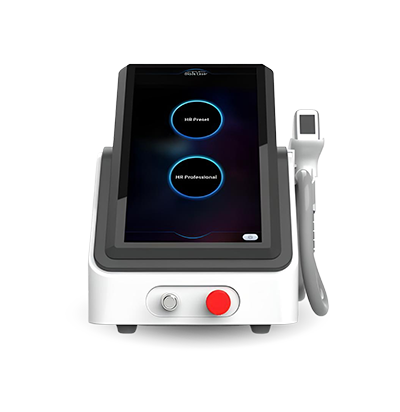
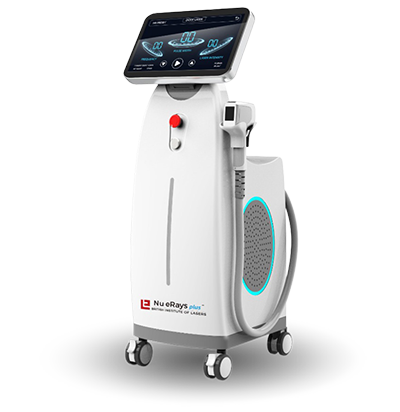
A machine comparison becomes useful only when it starts with your clinic rather than a specification sheet. A compact room can make the smallest machine the strongest commercial choice. A growing clinic may benefit more from skin analysis and precision tips. A high-volume operator can justify controls and shot life that save minutes across every appointment.
This guide translates the current British Institute of Lasers range into those practical decisions, with official product clips, a quick-fit selector and a side-by-side ownership comparison.
The treatment foundation is shared
The models are not separated into a basic clinical system and a capable one. Each combines Alexandrite, Diode and Nd:YAG wavelengths, covers Fitzpatrick skin types I to VI and reaches pulse rates of up to 10 Hz. The clinical principle is selective photothermolysis: wavelength and pulse settings are chosen to heat the target pigment while limiting damage to surrounding tissue.1 That means the shortlist can focus on the way the machine will be used rather than whether it can serve your client base.
What actually changes between modelsThe footprint, precision and workflow tools, output profile, guaranteed shot life and finance illustration. Those differences affect room layout, staff rhythm, appointment capacity and cash flow far more than another badge on the casing.
Find the most natural starting point
Choose the answer closest to your current plan. The selector is a commercial shortcut, not a substitute for a live demonstration, but it exposes the trade-offs quickly.
Which machine fits your working model?
Three choices produce a practical recommendation and a fit score.
Watch the machines in context
The cards below pull video media from the current British Institute of Lasers product and technology pages when this article is running on the website. That keeps the embeds tied to the media already maintained in WordPress rather than duplicating large video files inside the article.
Loading the official Nu TriLaze Plus clip...
Nu TriLaze Plus
Look for interchangeable tip handling, the guided interface and the way assessment tools support a consistent consultation-to-treatment flow.
Loading an official Nu TriLaze Lite clip...
Nu TriLaze Lite
Pay attention to its tabletop footprint, handpiece presentation and how comfortably it can be repositioned in a smaller or shared treatment room.
Loading an official Nu eRays Plus clip...
Nu eRays Plus
Watch the handpiece-led workflow and imagine the cumulative time saving when settings need to change repeatedly across a full treatment day.
Editor and staging noteThe automatic media lookup is same-origin. In a local file preview or an editor that blocks page fetching, each card keeps its product image as a fallback. The product links remain in the shortlist below. You can also set a fixed data-video-src attribute on any card to bypass lookup completely.
Choose by the work the machine needs to do
Nu TriLaze Lite
The lowest entry point and smallest footprint- Desktop or stand-based format that moves between rooms.
- SuperCool™ contact cooling and straightforward water maintenance.
- Less than 1p per 20 shots, with training and lifetime support included.
Nu TriLaze Plus
Assessment and precision features added to the core platform- Interchangeable tips make small and awkward areas easier to approach.
- Built-in assessment tools support more consistent setting selection.
- Enhanced output and less than 1p per 100 shots suit a fuller diary.
Nu eRays Plus
Handpiece control and long-life capacity for busy rooms- Adjust key parameters without repeatedly returning to the console.
- High output and up to 10 Hz keep large-area appointments moving.
- Less than 1p per 100 shots and a 25 million shot guarantee.
The differences that affect a normal working week
| Clinic consideration | Nu TriLaze Lite | Nu TriLaze Plus | Nu eRays Plus |
|---|---|---|---|
| Best natural fit | Compact, shared or mobile rooms | Growing and established clinics | High-volume dedicated rooms |
| Wavelengths | 755 / 808 / 1064 nm | 755 / 808 / 1064 nm | 755 / 808 / 1064 nm |
| Skin types | I-VI | I-VI | I-VI |
| Pulse rate | Up to 10 Hz | Up to 10 Hz | Up to 10 Hz |
| Portability | ✓ | Fixed | Fixed |
| Skin analyser / HD detection | - | ✓ | - |
| Interchangeable precision tips | - | ✓ | - |
| Direct handpiece workflow | Useful controls | Integrated interface | Direct in-session control |
| Guaranteed shot life | 3 million | Confirm current quotation | 25 million |
| Indicative running cost | <1p / 20 shots | <1p / 100 shots | <1p / 100 shots |
| Illustrative finance | From £174/mo | From £291/mo | From £232/mo |
The supplier package is part of the comparison
British Institute of Lasers brings more than 29 years in the sector, over 1,000 machines supplied and a reported average customer rating of 4.9 stars. The day-to-day value shows up in training, practical support and how quickly a clinic can recover from a fault.
Take your real clinic constraints into the room
Measure the route, not just the room
Check doors, stairs, treatment-bed clearance, ventilation and where the practitioner will stand. A machine that fits the floor plan can still interrupt the workflow.
Model a normal week
Use realistic appointment numbers, average treatment prices and staff hours. High-volume features have value only when the diary will use them.
Let every operator hold the handpiece
Screen layout, balance, cable movement and control placement affect fatigue and consistency. Those details are easier to judge live than in a brochure.
Frequently asked questions
It keeps the same three core wavelengths, skin-type range and pulse-rate ceiling as the larger models. What it gives up is the Plus model's assessment and precision hardware and the eRays model's high-volume durability emphasis. For a compact room or a diary still being built, that can be a sensible trade rather than a compromise.
It is the range's strongest all-rounder when a clinic expects steady growth and will genuinely use interchangeable tips, HD detection and the built-in skin analyser. Those features are especially useful where several practitioners need a repeatable consultation and setting-selection process.
A dedicated treatment room with regular daily use. Direct handpiece controls and a 25 million shot guarantee matter most when the machine is being worked hard enough for small workflow savings and long-life capacity to compound.
It should shape the cash-flow test, but not decide it alone. A lower payment can be poor value if the format slows a busy clinic, while a higher payment can be unnecessary if the extra tools will sit unused. Compare the payment with realistic sessions, room constraints, running costs and the support included.
Compare the handpieces, interfaces and footprints in one session.
The quickest way to settle the shortlist is to see more than one machine during the same demonstration. Bring your room dimensions, expected treatment mix and questions about finance, training and downtime.