


Ordering everyday goods from overseas feels ordinary. A professional hair removal laser machine or tattoo removal laser machine needs a stricter buying process. It sends concentrated energy into skin, must perform consistently and may need to satisfy insurers, local checks and safety advisers.
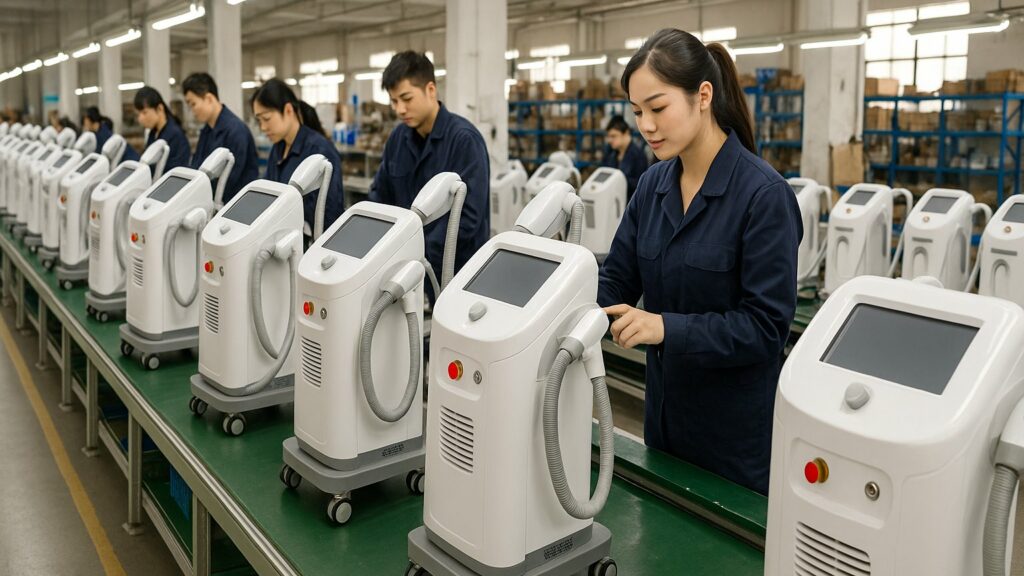
China has reputable manufacturers as well as factories and resellers offering poorly documented equipment. The sensible warning is not that every Chinese machine is unsafe. It is that a direct import can leave the clinic carrying responsibility for verification, shipping, technical support, replacement parts and downtime. A low invoice can become an expensive machine surprisingly quickly.
Work out what the quotation leaves out
A marketplace listing may show the factory price rather than the amount required to put a working machine into a UK treatment room. Ask for a written quotation covering freight, insurance, import duty, VAT, customs handling, installation, accessories, protective eyewear, training and any initial servicing. Check who carries the loss if the machine arrives damaged.
Power supplies, cooling systems, optics, laser rods and handpieces can look alike while differing sharply in durability. The supplier should identify the exact model, manufacturer and component specification.
A useful buying ruleDo not compare the overseas invoice with the complete price of a UK-supported machine. Compare the full landed, trained and operational cost of both options.
Treat every certificate and specification as something to verify
Logos on a listing are not evidence. Request applicable conformity information, test reports, declarations, serial-number details, an English manual and evidence behind any FDA approval claim. Ask your insurer to review the exact model before committing funds.
Government guidance says businesses placing manufactured products on the Great Britain market must follow the regulations applying to them. Direct importing may therefore transfer responsibilities normally handled by an established UK supplier.1 Every certificate should trace to the correct manufacturer and model.
- Check the specification: wavelength, energy delivery, pulse width, spot size, frequency and cooling should be stated clearly.
- Check traceability: serial numbers, manufacturing records and service history should be available.
- Check the paperwork with third parties: ask your insurer, local authority and safety adviser what they expect.
The weakest support arrangement usually appears after payment
A machine fault can mean cancelled appointments, refunds and interrupted treatment courses. Ask where engineers are based, which parts are stocked in the UK, who pays return freight and how long the clinic may be without equipment.
Some engineers will not work on unfamiliar platforms without service information and reliable parts access. A video call cannot replace an engineer, a stocked component or a temporary replacement machine.
| Buying issue | Low-price direct import | Established UK-supported supply |
|---|---|---|
| Initial payment | Often lower before freight, tax and setup | Usually higher but more costs are visible |
| Documentation | Buyer may need to verify every claim | Supplier should provide model-specific records |
| Training | May be brief, generic or remote only | Machine-specific learning and practical guidance |
| Fault response | Overseas returns and uncertain parts access | UK troubleshooting, engineering and defined escalation |
| Business risk | Clinic carries more technical and downtime exposure | Greater supplier accountability after purchase |
A machine manual does not prepare a practitioner to treat clients
Useful training should cover laser science, consultation, contraindications, patch testing, setting selection, controls, maintenance, documentation and aftercare. Core of Knowledge learning is only one part of this. Training and certification do not automatically secure insurance acceptance or council approval.
England's proposed licensing framework addresses practitioner competence, indemnity and premises standards.2 Requirements vary across the UK and locally. A qualified Laser Protection Adviser can support risk assessments, local rules and safety documentation, without guaranteeing approval.
Choose accountable supply rather than an anonymous box
British Institute of Lasers supplies FDA-approved equipment with free Core of Knowledge learning, bespoke machine training and lifetime UK-based support. Its three professional hair removal laser machines treat all skin types and combine Alexandrite at 755 nm, Diode at 808 nm and Nd:YAG at 1064 nm. They also use SuperCool™ technology, cost approximately 1p per 200 shots and include a first-year guarantee covering 50 million shots.
For tattoo removal, the Nu Tatouage Plus uses Q-switched Nd:YAG technology at 1064 nm and frequency-doubled 532 nm for common dark and selected warmer pigments. Results depend on the tattoo, skin and treatment plan, and not every colour responds.
Support is the larger distinction. Lifetime guidance covers operational questions, troubleshooting, routine maintenance and refresher help. If a qualifying machine fault cannot be resolved on site, a replacement unit will be dispatched within 72 working hours under the 72-hour machine-swap guarantee, helping reduce extended downtime while the machine is repaired.
Questions to answer before sending a deposit
- Has the insurer reviewed the exact model and supporting documents?
- Who is legally and practically responsible for placing the machine on the UK market?
- Can the supplier prove the stated wavelengths, output and cooling performance?
- Where are parts held, who can repair the machine and what happens during a long fault?
- Does the training cover safe treatment decisions, maintenance and documentation?
Inspect the machine, paperwork and support before comparing prices.
A no-obligation demonstration gives you time to test the interface, inspect the handpiece and ask direct questions about training, maintenance, finance and fault support.