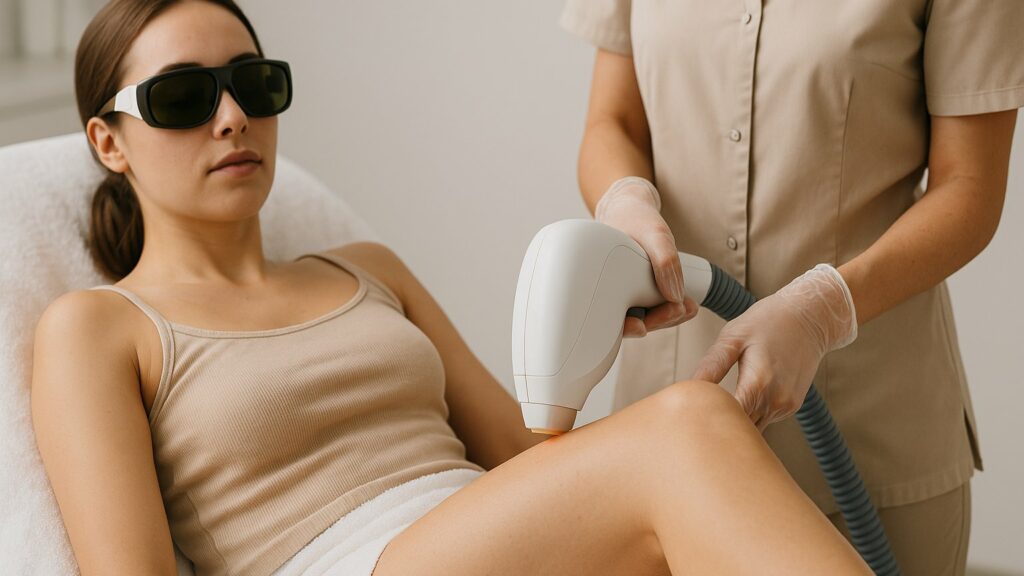
Choosing between IPL and a professional laser hair removal machine affects client results, treatment speed and clinic margins. Below is a straightforward comparison, along with where British Institute of Lasers fits for clinics that want dependable kit,…
By Dr Majid ZarandouzPublished 10 February 2017Updated 8 May 20265 min read
In this guide
Choosing between IPL and a professional laser hair removal machine affects client results, treatment speed and clinic margins. Below is a straightforward comparison, along with where British Institute of Lasers fits for clinics that want dependable kit, practical training and fast UK support. Demand is rising in the UK, with laser hair removal now overtaking injectables in popularity, according to Rare Consulting.
Energy focus: Less concentrated than laser. It can treat larger areas, though the energy is more diffuse.
Best fit: Lighter skin with dark hair, tighter budgets, home devices and some salon services.
02. True laser in brief
Light source: A single wavelength for more precise melanin targeting and steadier follicle heating.
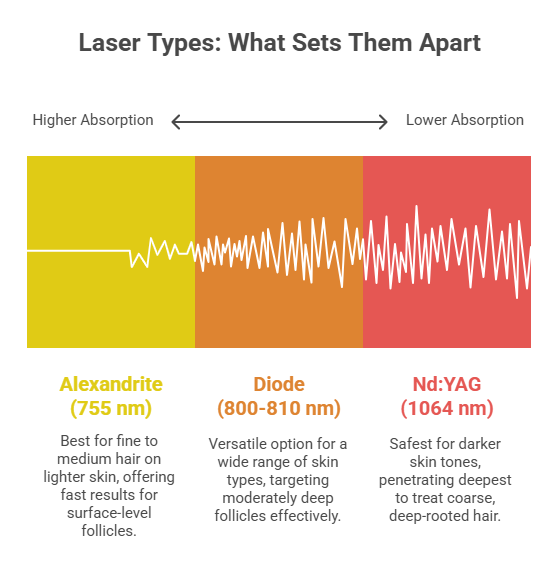
Wavelength choice: Alexandrite 755 nm, Diode 808 nm and Nd:YAG 1064 nm for safer treatment across skin types I to VI.
Best fit: Professional clinics that need reliable results, quicker treatment times and broad skin tone coverage.
Laser hair removal works through selective photothermolysis, which targets melanin in the hair while helping protect the surrounding skin. You can read the science explained by Mayo Clinic and a concise overview of melanin’s role here: melanin and laser.
Speed, comfort and session count
Technology
Speed
Typical Sessions
IPL
Moderate
8 to 12
Laser three in one
Fast
6 to 8
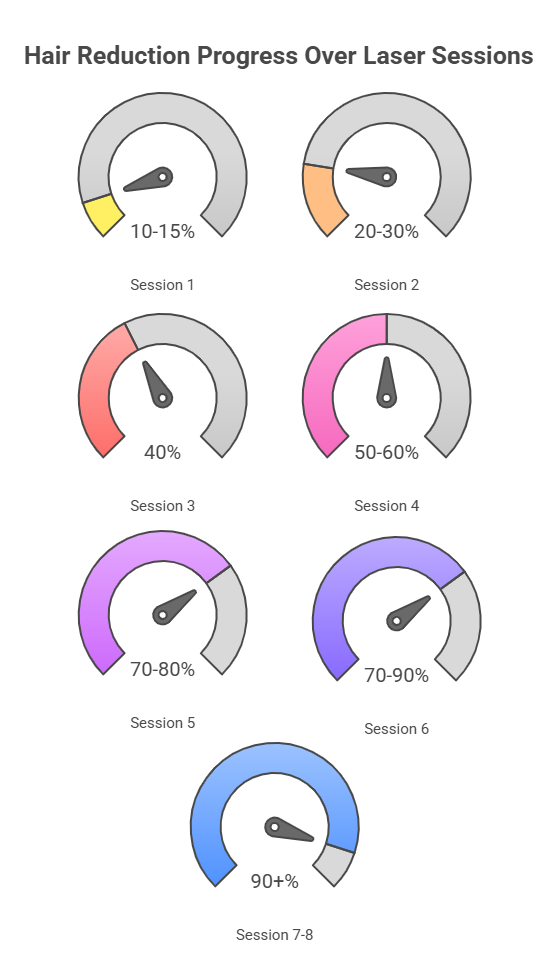
Treatment timelines vary with hair density, hormones and the area being treated. The guide image below is useful for setting realistic client expectations.
Skin tones, hair types and wavelength choice
Skin tone matters. Strong contrast between hair and skin is usually easier to treat. For darker skin, Nd:YAG 1064 nm is often the safer choice because it penetrates deeper and avoids epidermal melanin more effectively. See our wavelength snapshot below:
For a closer look at safe laser choices for darker complexions, visit our article on laser hair removal for Afro Caribbean skin. We also cover treatment phases and why multiple sessions matter in our guides on after 3 sessions and after 6 sessions.
Safety, regulation and training in the UK
Licensing for non surgical cosmetic procedures in England is moving into a more formal framework. According to the GOV.UK consultation, a licence will be required and practising without one will become an offence. Clinics often appoint an LPA and LPS to support safe governance. We can help with that through our Laser Protection Advisor service.
Every British Institute of Lasers machine comes with free training and certification options. You can choose a full day in Coventry or our online route. The programme covers Core of Knowledge, device operation and maintenance, skin typing and safety. That supports insurance applications and local authority requirements in the UK.
Why many clinics prefer laser over IPL
03. Practical benefits for busy teams
Consistency: Single wavelength targeting, repeatable results and clearer treatment protocols.
Coverage: With 755, 808 and 1064 nm in one system, you can treat skin types I to VI with more confidence.
Throughput: Faster pulse rates help shorten appointments and increase daily capacity.
Comfort: Advanced cooling can reduce discomfort and keep downtime low.
Device improvements continue to expand safety and suitability across skin types, as noted by industry research. Demand is climbing too, with millions of UK consumers planning treatment, according to Rare Consulting.
Our laser hair removal systems
All three of our laser hair removal machines are FDA approved and built for busy clinics: see the full range.
Nu TriLaze Plus: 3 in 1 with a built in skin analyser, HD detection and interchangeable tips for more detailed work. View Nu TriLaze Plus.
Nu eRays Plus: Handpiece control for speed and accuracy, low running costs and excellent cooling. View Nu eRays Plus.
Nu TriLaze Lite: A portable 3 in 1 platform with SuperCool technology and very low operating costs. View Nu TriLaze Lite.
We also offer a 24 hour swap guarantee to help keep your clinic running with minimal disruption.
What about IPL for home users?
IPL can still be a sensible option for lighter skin and darker hair when budgets are limited and expectations are more modest. It can also work well for maintenance between professional courses. For a balanced read, try our guide on at home devices and learn the basics in what is IPL hair removal.
Decision guide for clinics
Quick checklist
Client mix: Do you regularly treat a wide range of skin tones and hair thicknesses?
Throughput goal: Are shorter appointments and higher daily capacity important to you?
Operating cost: Do low cost per shot and straightforward maintenance matter for session profit?
Learning curve: Would in person training and lifetime support help new staff settle in faster?
Most professional teams choose a 3 in 1 laser system for consistency and flexibility. If you want a deeper look at the science behind IPL hair removal, our article on What is IPL Hair Removal goes into more detail. You can also explore which laser type is best for different situations.
Next steps
See a live demo: Book in Coventry or online via Book a Demo.
Speak to a specialist: Get specs, pricing and finance options at Request Details.
UK demand is growing quickly, with the market projected to reach about £73 million by 2030 as noted by Grand View Research. If you are planning to expand your treatment menu or replace older equipment, a precise, fast and economical 3 in 1 laser platform is a sensible long term choice.
Majid holds a PhD in organic chemistry and has been working with laser systems for decades. His career began in the mid-1990s, when he started researching and developing laser-based technologies for medical and cosmetic applications. Over the years, he has combined scientific expertise with practical engineering to design machines that are effective, durable, and straightforward to use in real clinic settings. As director of the British Institute of Lasers, Majid continues to focus on producing equipment that meets professional standards while remaining accessible to businesses of all sizes.
IPL & Other TreatmentsIPL vs Other Technologies
From the Knowledge Hub
Continue planning your laser service.
Explore more guidance on professional equipment, clinic planning, training and practical business decisions.



 For a closer look at safe laser choices for darker complexions, visit our article on laser hair removal for Afro Caribbean skin. We also cover treatment phases and why multiple sessions matter in our guides on after 3 sessions and after 6 sessions.