
Renting a hair removal laser machine can look like a cautious way to introduce laser hair removal. The monthly payment may appear manageable and the commitment may seem lighter.
For most clinics planning a lasting service, though, renting is rarely the strongest long-term choice. Payments can continue without creating an owned business asset, while the clinic may have less control over the machine, its history and the terms governing its use. Purchasing through suitable finance can offer a clearer route towards ownership.
The practical answer Renting may suit a genuinely short, carefully controlled trial. A clinic intending to build a lasting laser service will usually be better served by purchasing the right machine, using finance where required, and understanding the complete ownership package before committing.
Why renting can seem attractive at first
A new clinic may not know how quickly bookings will grow. Renting appears to reduce the size of the first decision, particularly while the owner is also paying for premises, insurance, room preparation, training and marketing.
Some agreements may include servicing or permit return at the end of a term. The difficulty is that the headline fee rarely tells the complete story. Contract restrictions, machine condition and support response matter more than the word "rental". A machine also does not create demand by itself. Consultation, patch testing, competence, pricing and room safety still need proper planning.
The rental agreement can carry more risk than expected
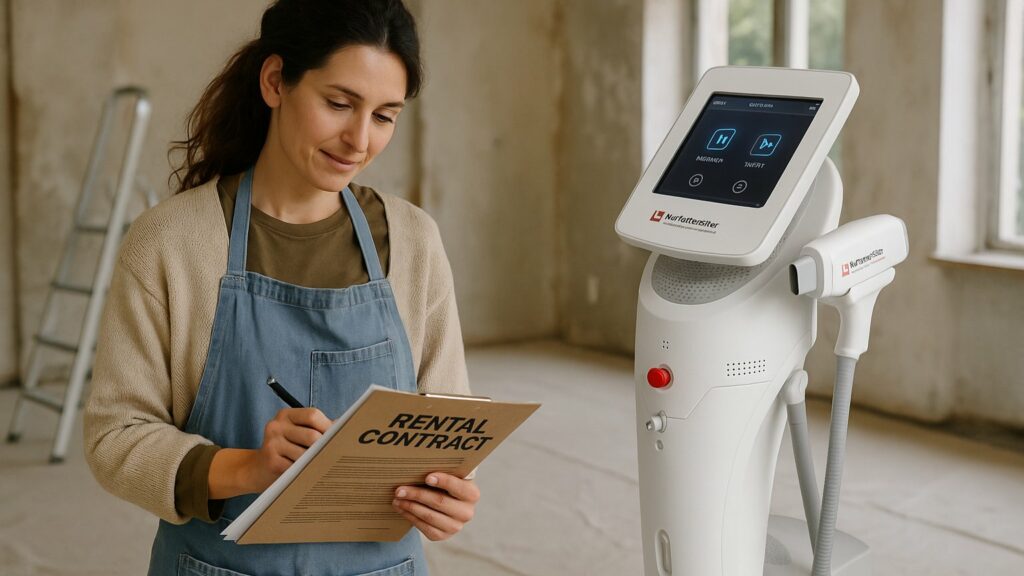
Read the entire agreement and calculate what the clinic may pay over the minimum term. Check whether the amount includes VAT, delivery, collection, servicing, repairs, replacement handpieces, consumables and training. Ask whether payments continue while the machine is unavailable.
Other clauses can affect daily use:
- Usage limits: Does the agreement cap treatments, pulses or operating hours, or charge more when usage rises?
- Cancellation: What happens if bookings are slower than expected, the clinic moves or the service is discontinued?
- Damage responsibility: Who pays for accidental damage, misuse, transport damage or parts excluded from routine servicing?
- Machine history: Is the unit new, refurbished or previously used, and are service and shot records available?
- Downtime: Is a replacement machine promised, how quickly will it be dispatched and which faults qualify?
- End of term: Does the clinic own anything after making all required payments?
A low starting payment can become expensive once a long term, return fees or usage charges are added. It may also leave a growing clinic dependent on equipment it cannot sell or retain.
Ownership gives the clinic more control
Purchasing creates a clearer relationship with the equipment. The clinic can build protocols around one familiar machine, train team members consistently and plan capacity without depending on a rental renewal.
The machine also becomes a business asset, subject to the finance agreement and normal accounting treatment, rather than equipment returned after months or years of payments. Ask an accountant how this applies to your circumstances.
Control matters once treatment courses have been sold. Changing machines may require new training, revised documentation, insurer notification and fresh patch testing where appropriate.
The guide to the cost of a professional hair removal laser machine explains why the purchase price should be considered alongside training, running costs, maintenance and support rather than viewed on its own.
Finance can provide the monthly structure people seek from renting
Many clinics consider renting to avoid paying the full purchase price immediately. Finance may be more useful because it spreads payments while supporting eventual ownership, subject to the agreement.
Current indicative finance figures from the British Institute of Lasers begin at £174 per month for the Nu TriLaze Lite, £232 per month for the Nu eRays Plus and £291 per month for the Nu TriLaze Plus. Finance is subject to status, affordability and lender approval. Terms may change, so request a current written quotation. No deposit is required under the currently advertised options.
Do not compare a rental payment and a finance payment without comparing the term, total payable, included support and ownership position at the end. The cheaper monthly number may not be the lower-cost business decision.
Look at what comes with the machine, not only the machine itself
The Nu TriLaze Lite, Nu TriLaze Plus and Nu eRays Plus share the same professional foundation. All three treat all skin types and combine Alexandrite at 755 nm, Diode at 808 nm and Nd:YAG at 1064 nm. Each uses SuperCool™ technology to help facilitate painless hair removal treatments, while still allowing for individual differences in sensation.
They are FDA approved, low maintenance and fitted with intuitive interfaces. Running costs are approximately 1p for every 200 shots, and each includes a first-year guarantee covering 50 million shots. This does not mean the handpiece stops working at that figure.
Every purchase also includes free Core of Knowledge learning, bespoke machine training and certification, and lifetime support. Training can cover consultation, patch testing, contraindications, setting selection, controls, cleaning, documentation and aftercare. Continuing support may include troubleshooting, maintenance advice, water-change guidance and refresher help for new staff.
If a qualifying machine fault cannot be resolved on site, the 72-hour machine-swap guarantee means a replacement unit will be dispatched within 72 working hours, helping the clinic reduce extended downtime while its machine is repaired.
The following video shows the three hair removal laser machines together, making it easier to compare their size, controls and practical clinic setup before deciding which model fits your room and workflow.
Choose for the clinic you are building
The differences between the machines become clearer once the shared platform is established.
- Nu TriLaze Lite: The compact and portable option, suited to smaller rooms, shared premises and clinics seeking the lowest monthly finance point. Its output is lower than the Plus and eRays Plus, but it still treats all skin types.
- Nu TriLaze Plus: The most feature-rich option, with a built-in skin analyser, interchangeable precision tips and higher output than the Lite. It suits practitioners wanting closer visual assessment and accurate access to small or awkward areas.
- Nu eRays Plus: A more affordable alternative to the Nu TriLaze Plus, offering higher output than the Lite and direct controls on the handpiece without the skin analyser or interchangeable tips.
Review the complete range of hair removal laser machines for clinics by considering available space, treatment volume, portability, precision, workflow and growth plans. Buying a machine that fits those needs is usually more sensible than renting whatever model happens to be available.
When might renting still be reasonable?
A short rental could make sense for a defined event, a temporary treatment room or a tightly controlled pilot where the clinic is not ready to establish a permanent service. Even then, training, insurance, local-authority requirements, patch testing and room safety still apply.
Set a firm trial period and success criteria before signing. Measure enquiries, consultations, course sales, appointment utilisation and the total rental cost. If the intention is already to offer laser hair removal for several years, a temporary arrangement may simply delay the ownership decision while adding another layer of cost and uncertainty.
For a committed clinic, purchasing is usually the stronger route
The British Institute of Lasers sells machines and does not offer rentals. Ownership supports consistent training, familiar treatment delivery, clearer control over the asset and access to lifetime support.
Renting makes the first decision feel smaller, but proper commercial planning is still required. The clinic should know its likely treatment volume, pricing, staffing and compliance costs. For many businesses, finance provides a manageable monthly structure while building towards ownership. Compare the total payable, support package and end position, not only the smallest monthly figure.
Compare the machines before choosing how to fund one.
A no-obligation demonstration allows you to see the machines operating, review their controls and discuss training, running costs, maintenance, finance and lifetime support. The aim is to choose equipment that fits the clinic for the long term.