


Laser hair removal can keep regrowth low for a long time, and for many clients that means smoother skin for months with only the occasional maintenance top up. What matters most is how much the follicles settle, how slowly hair comes back and how much less of it you are dealing with. That can vary with hair type, hormones, the area treated and the technology used.
Facial areas often need more regular maintenance because the hair cycle moves faster and hormones can have more influence there. Body areas usually hold their results for longer.
What does “lasts” mean in practice
Laser targets pigment in the follicle and disrupts the growth cells in hairs that are in the active phase. Because hair grows in cycles, treatments are spaced out to catch each new wave. Once a full course is done, most people notice much longer gaps between regrowth and far fewer active hairs. Maintenance usually becomes occasional rather than constant. The general science is outlined by the Mayo Clinic.01. Typical longevity by area
Guide ranges for clients who complete a full course on a professional device.| Area | After your course | Top up rhythm |
|---|---|---|
| Underarms | Strong reduction with very slow regrowth | Every 6 to 12 months |
| Bikini | Long spells of smooth skin, with finer return | Every 6 to 12 months |
| Legs | Broad clearance with very gradual return | Every 12 to 18 months |
| Face | Noticeable reduction, though hormones can speed regrowth | Every 3 to 6 months |
| Back or chest | Strong reduction, with density easing over time | Every 6 to 12 months |
What affects how long it lasts
- Hair colour and thickness: darker, coarser hair usually responds faster and tends to stay quieter for longer. Finer or fair hair often needs more patience and more maintenance.
- Skin tone and wavelength choice: matching Alexandrite, Diode or Nd:YAG to your skin type improves safety and helps clinics use effective settings.
- Hormones: PCOS, pregnancy, peri menopause or certain medicines can reactivate follicles. That often changes top up timing, especially on the face and abdomen.
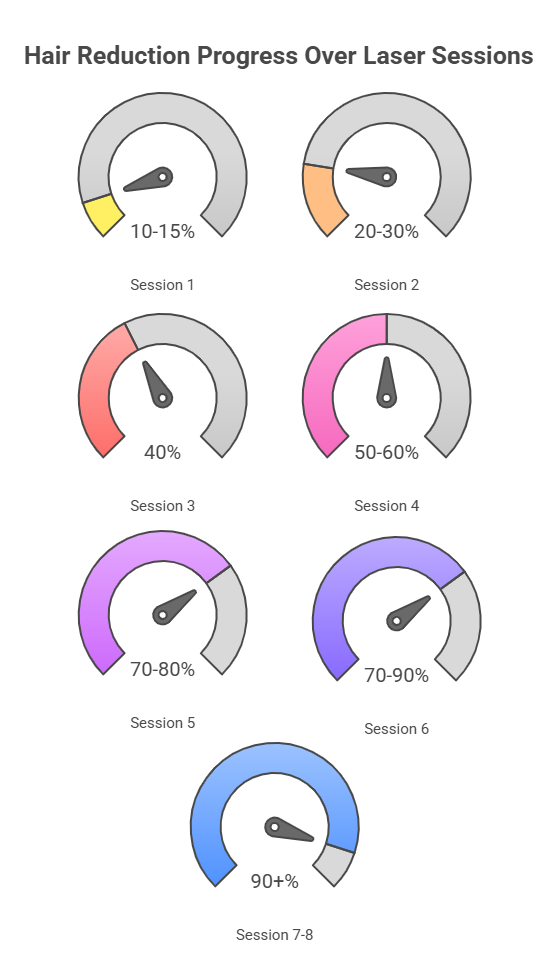
- Completion of your course: clients who finish the full series, usually six to eight visits, tend to keep results for longer than those who stop halfway through.
- Device quality and cooling: steady energy delivery and strong cooling can make higher settings more tolerable, improve coverage and support better long term results.
02. How many sessions for a lasting result
Most people need six to eight sessions, spaced four to six weeks apart for the face and six to eight weeks apart for the body. You will usually notice shedding after the first few appointments, then patchier and finer regrowth by session three or four. Clients often ask about side effects too. Common reactions such as mild redness or tiny swellings around the follicles usually settle within two to three days, as noted on Wikipedia.- Early checkpoint: read what to expect after three sessions.
- End of course: see is six sessions enough for a clearer sense of timing.
The tech choice that supports longevity
Three wavelength systems give clinics broader coverage across skin tones, with settings that support comfort and strong results. Our platforms combine Alexandrite 755, Diode 808 and Nd:YAG 1064 in one unit with integrated cooling.- Nu TriLaze Plus: built in skin analyser, HD detection and strong cooling for fast, assured sessions. Nu TriLaze Plus
- Nu eRays Plus: on handpiece controls and dependable comfort, which helps clients stay on schedule. Nu eRays Plus
- Nu TriLaze Lite: compact, mobile friendly and very low in running cost, which suits multi room setups well. Nu TriLaze Lite
03. Make results last even longer
- Finish your course: stopping early usually means a shorter maintenance window.
- Shave only between visits: avoid waxing or epilating during a course. The root needs to be there for the laser to target it properly.
- Protect from sun: avoid tanning for two weeks before and after treatment. Use SPF on exposed areas.
- Plan maintenance: one or two quick top ups a year can keep things settled, especially on the face and bikini line.
- Match wavelength to skin type: deeper skin tones often suit Nd:YAG with longer pulses for comfort and steady results.
Quick answers
- Is it permanent: it delivers long term reduction. Many follicles stay quiet for months or even years, though some will need occasional maintenance because of hair cycles and hormones.
- How many sessions: six to eight for most areas, with top ups later if needed.
- Is it safe for my skin tone: yes, with the right wavelength and proper cooling. For deeper tones, read our guide for Afro Caribbean skin.
- Does it hurt: modern cooling makes treatment much easier to tolerate. See how painful is laser hair removal for comfort tips.